Tuesday, June 19, 2018

Coaching 1st Time Ironman Athletes

I've had the privilege of coaching multiple athletes through their first ironman, and it is absolutely one of my favorite things to do as a coach. What I've noticed, is that it doesn't matter what level the athlete is at, what their goals are for the race, how long they've been in the sport, etc. They all go through a very similar mental process, complete with emotional highs, lows, wanting to quit, feeling on top of the world, feeling not good enough, feeling tired, scared, overwhelmed, fat, tired, wondering why they still have to go to work while they're ironman training, being pretty sure they could qualify for Kona, pretty sure they're never going to finish, and again, tired. I'm almost at the point that I can predict how our phone calls are going to go based on where they are in training. One of the things that I always want them to know though, is that all of those feelings are universal and "normal" (normal for ironman athletes), even when it feels like they're going insane inside their own head. So this is blog post outlines a little bit about what that journey looks like, and what you should expect if you're thinking about signing up for your first ironman.

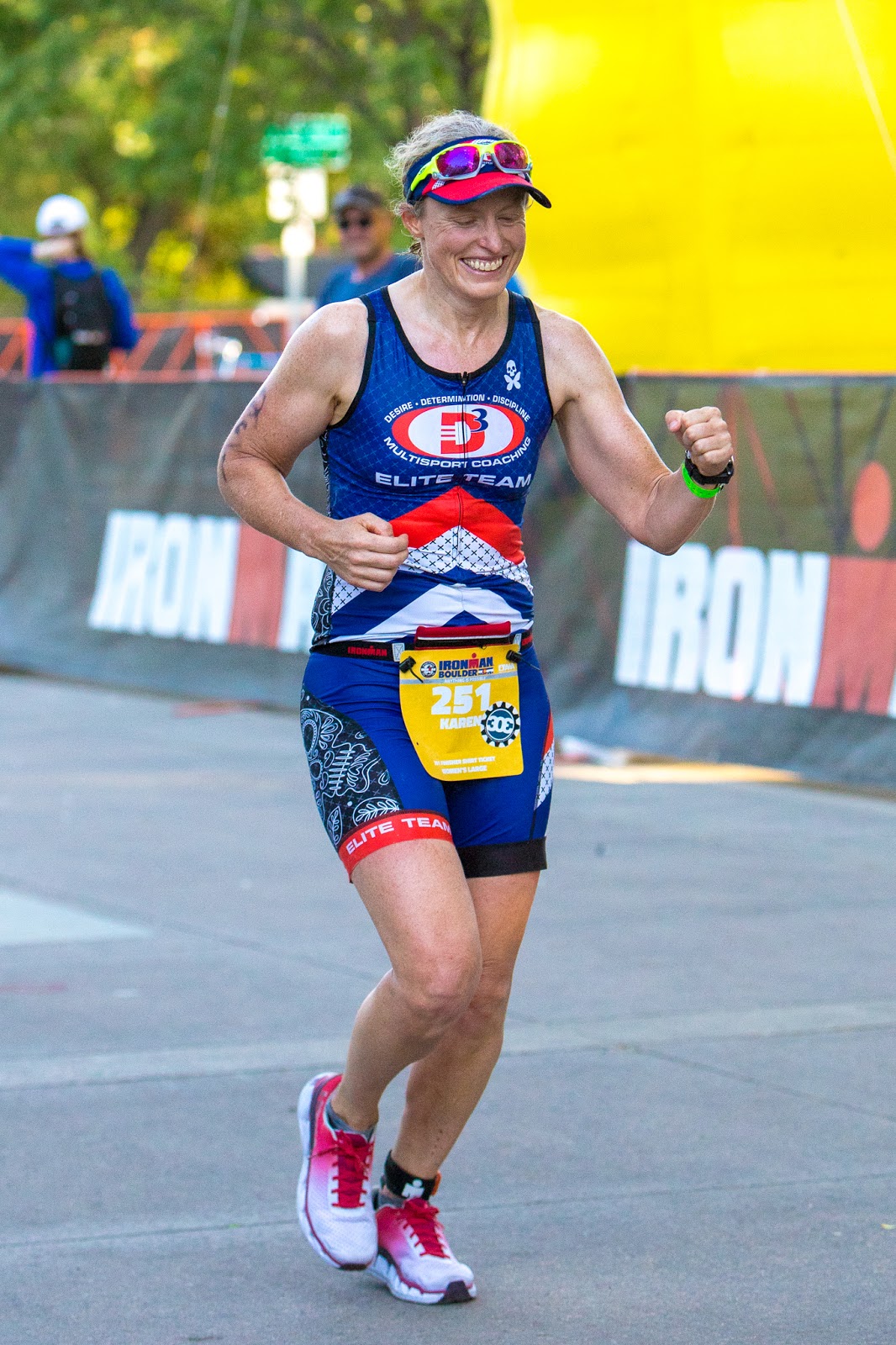
(The pictures interspersed throughout this post are random pictures of my athletes participating in Ironman Boulder 2018. Not all of them were first timers, but all of them are awesome. Photo credit to my sister: Gina Eichert.)


The first step is exciting: emptying your bank account on a race entry fee. The minute you press that button, you're committed to a journey that is going to change your life. Let's be honest, who actually buys the insurance for your entry fee? The subsequent thought process changes quickly to, "What the fuck did I get myself into," along with a mild stomach ache. Sometimes I'm already coaching athletes at this point, but sometimes this is when they realize they need a coach.

Hopefully you've signed up more than a few months out from the race, which gives us plenty of time to gradually build fitness. I also use these beginning weeks to figure out what makes them tick, what they really want out of this journey (whether they consciously know what that is or not), and how to keep them motivated. Usually the first few weeks are relatively easy so that they can start to figure out how ironman training is going to fit into their lives, and also so that I can trick them into thinking that it's not going to be that bad. Managing emotions starts early. Soul crushing is for later on.

Then we start to build. Remember when you used to have friends and spent your time relaxing on the weekends? Me neither. Now your bike is your friend, so hopefully you've named it and gotten a comfortable saddle.

Building aerobic fitness is priority #1, so we build to 3-4 hour rides on the weekends pretty quickly. Usually around this point, I start getting phone calls from athletes trying to figure out how they're going to be able to go to their friend's wedding or their family reunion, and still fit in their training. Those things didn't seem like a big deal a few months ago, but now you're training for an ironman and everything is overwhelming. Should you skip the wedding? Should you take off work? Personally, my favorite choice for myself is taking off work to do more training, but then you also have to consider how you're going to afford your next ironman. So many decisions to be made on so little brain power.


8 weeks out to 6 weeks out: "Overwhelmed:"
The ironman is approaching faster than you're comfortable with, and even though your body feels like it's falling apart, and you can't keep your eyes open at work, it seems like you're not doing enough. But also too much. It's confusing. All you know is you're tired, and you might want to cry a little bit.

One of the cool things that starts to happen around this time, is that there are always a few workouts where you get to really learn how tough you are. They go something like this: you're going into a workout thinking something like, "I can barely stand up straight. I don't know how my stupid coach thinks I'm going to be able to run." But you do it anyway, because it's on Training Peaks, and you always do what's on Training Peaks because a few weeks back, you stopped having the ability to think for yourself. And then something magical happens. Your legs have taken on this life of their own and they're actually running! And they're running kind of fast! You're not really sure what to do about this, so you just try not to question it, and let your legs do their thing. The lesson you need to hold onto from these workouts is that your body is incredibly strong, and usually it's stronger than your mind gives it credit for.

Don't give up, even when it feels impossible, because that is when the biggest breakthroughs happen.


6 weeks out to 4 weeks out, aka- peak weeks: "Doubt:"
This is the most mentally challenging block, not surprisingly, because it is also the most physically challenging block. This is when you have to know your "why." Remember back in the beginning, when I was asking you all those nosey questions about your life, and your family, and what you've been through? This is where that comes in handy. Your body is capable of incredible things if you are mentally prepared to take it there. Most of us have at least considered this idea, in order to have signed up for an ironman and gotten this far into training for it, but this is where you have to dig deep.

The phone calls that I get in this block are typically filled with insecurity and fear. Your training has gotten to such a level that you are getting a taste of exactly how hard it is to do an ironman, and what you've come to realize, is that it's really fucking hard. It's scary because you've never done anything this difficult before and it's natural to doubt your ability to reach new limits. For me, this right here is the best part about being a coach. If I can give you even a little bit of confidence, I get to sit back and watch you do amazing things. I know that you, along with the small percentage of batty people on this planet (myself included) who at some point thought it was a good idea to do an ironman, have an underlying desire to prove to yourself that you are limitless. Figuring out why you want this is part of my journey with each individual athlete, but regardless of why, I know that it's there. It's what unites us as a community of ironmen (or insane people, whatever you want to call it). It is my responsibility and privilege to remind my athletes exactly how capable they are, and it is my hope that my belief in them will inspire them to believe in themselves and persevere.


They key workouts to log away for your race-day memory bank from this block are the opposite of what happened in the "overwhelmed" block. You have a big workout on your schedule, and you're determined to do it, but halfway through, your body has just had enough. You hurt, you're probably a little dehydrated, and you've just been going so hard for so long. There might be a brief period where you stop and feel bad for yourself, and maybe shed a few tears, but you've already learned how resilient your body is, so you are going to drag yourself through this thing, kicking and screaming, because you have an ironman to do, and nothing is going to get in your way. I don't have to tell you what a big deal this is. You know.

2-3 weeks out: "Re-awakened:"
We're starting to taper and you're beginning to feel like your old self again. I don't have kids but I can imagine it's similar to when your baby first starts sleeping through the night. You almost forgot what it's like to have full use of your brain, have time to clean your house, and show up for work with clean hair. It feels pretty damn good. But with this new brain capacity, comes space for realizing that your ironman is right around the corner, and you are just about out of time to build fitness for it. Everything that has to be done in order to become an ironman, has to have been done by now, and you have a whole lot of extra time on your hands to think about that. Which leads us to our next phase: "insanity."

RACE WEEK: "Insanity:"
Race week is here, whether you're ready or not. If I'm your coach, you're ready. You've trained, you've figured out what a special needs bag is, you've made your race plan, and nailed down your nutrition strategy. Now you're experiencing your first ironman taper, which feels a lot like schizophrenia, except that you're fully aware of your insanity. If you've never experienced this before, "taper," can be described as a state of mind comprised of the following thoughts and feelings: hungry, cranky, moody, happy, sad, nervous, tired, anxious, fat, injured, excited, constipated, and manic.

Race week is my last chance, as your coach, to let you know how awesome you are and how far you've come. You have one really hard day ahead of you, but you've endured months of hard days, and you've persevered. Your resilience is what will get you to the finish line. Race day is a celebration of your hard work, but that doesn't mean it's going to be any less difficult. The celebration is about the fact that you have had the strength and courage to get yourself to the start line, and that you're ready to experience all of the ensuing pain and suffering, without letting it stop you. You're about to be an IRONMAN.

If you're still wondering if it will be worth it, these finish line pictures should convince you:




Monday, April 30, 2018

Ironman Texas Race Report

Ironman Texas was the first race post Korey Stringer, that I actually had my hydration plan figured out. I wasn't nervous about repeating the events of IM Los Cabos because I knew that Dr. Rob Huggins and the team at KSI had given me everything I needed to solve my bloating problem. I also felt confident that if it started happening again, that I would be able to correct it, and not continue to go downhill and end up in the medical tent, like before.

The Woodlands was an awesome race venue. I'd absolutely recommend it for an ironman, especially if you're looking for a PR. My support crew at this race was supposed to just be Ryan and my mother-in-law. However, the first night at dinner, my sister Heather showed up! If you guys don't know how awesome Heather is, just watch this video. She's the one dancing amongst the Wattie Ink crew with my 2 dog faces.


Then the next day, Gina showed up! If it was ever in question how much I love my sister, here's this:


And just when I thought that was all of the surprises, on our way to the race start in the morning, my brother Carl gets out of his car with the 2 giant dog face cut-outs that Ryan had made for me. I have to admit, I was excited to see Carl, but I was a little distracted by my cute dogs' faces on giant poster boards. I've always known that my dogs were meant to be famous, but it was funny to see all of the athletes and spectators wanting to take pictures with them on race morning.


The swim was ok. I thought I would be able to swim under an hour since I've been swimming so well in training recently but I came out with a 1:02. The swim is such a short portion of the race though, that I try not to let it bother me, and just focus on what's coming next. The second half of the swim course goes into a narrow canal where spectators can walk next to their swimmer (if they can find them in the masses), but Ryan always finds me, so I heard him cheering and out of the corner of my eye, I could see my dog faces, which made me really happy.


I hadn't done a flat bike course since my first ironman- IM Arizona in 2015. I knew I was due for a bike PR, but I didn't know I was capable of a 5:09 bike split. This is where I really started putting my new nutrition and hydration plan into place. I had it all worked out for the mid-80 degree day that it was supposed to be, but the first couple hours on the bike were actually still relatively cool, and I forgot to take this into account at first. I got a little bit bloated in the first hour, but then I made an adjustment, and was able to fix myself and decrease the bloating. I backed off the fluid, but still focused on taking my salt sticks, and getting the right amount of calories from the shot bloks I had with me and grabbing bananas at aid stations. Potassium is my biggest concern because that's the electrolyte that I tend to excrete at a higher rate, so even though I wasn't sure what kind of effect the bananas would have on my stomach, I knew I had to take them in anyway to correct my electrolyte balance. 

Even though it was 2 loops out-and-back on the bike, I didn't get to see my crew halfway through because we stayed out on the highway. I was actually a little bit relieved about this because I didn't want them to see me bloated on the bike and get worried. I had it under control this time.

This is what my face looked like after my 5:09 bike split:


The run is my favorite part so I'm always excited to get off my bike. And I hadn't seen my crew in a while, and I missed them and their shenanigans. 

Sometimes I write things in my race plan, like "don't go under 8:00 pace in the first 5k," and then blatantly ignore it. This was one of those times. I just felt good and my legs felt like they wanted to be fast so I let them. They weren't bloated so they wanted to celebrate. I felt pretty good the first 2 loops (out of 3), but I could tell that my stomach was upset about having to take in all those calories without fluid on the bike. I had a hard time getting anything else in my body from that point on, and I ended up puking most of the third loop. I didn't stop to puke though, just let it come right out in stride. I've kind of always wanted to do that, and it was just as cool as I thought it would be. 

I knew I wasn't getting on the podium at that point, so I didn't let it bring me down. I just kept looking for my crew and kept a smile on my face. 


After what I went through at Los Cabos, I'll never take an Ironman finish for granted. I thought I was capable of a 10:15 at this race, but I still had a few things to work out with my nutrition. Still, I knocked off 30 minutes from my Ironman PR, and it will never get old coming down the finish shoot and hearing Mike Reilly say, "YOU ARE AN IRONMAN!" 

Being fast is important to me, but it's not the reason I do this. The best thing about being an ironman, is you get to continuously prove to yourself that you are capable of doing anything you want to do, if you work for it. And hearing my athletes and family and friends say that they're inspired by what I do, is everything.

Last but not least, I think it's pretty obvious what a great husband I have, but what he does behind the scenes for me is even more meaningful than what you get to see in pictures. Most of it we'll keep between the two of us, but my results on race day are the product his hard work and passion, just as much as mine.


Friday, March 9, 2018

KSI Results Part 2

Aside from the physical testing I went through at The Korey Stringer Institute, we also thought it would be beneficial to do a Sodium Balance Test, which consisted of a 24 hour diet log and urine collection. The purpose of the this test was to calculate my total sodium loss throughout an entire day, including what I lose through sweat and urine, in order to make sure I replace what I lose through my diet. We wouldn't be able to get to the bottom of my nutrition and hydration issues on race day without looking at the overall picture of how I'm fueling myself on a regular basis.

Here is the total sodium balance from the 24 hour period (which included both of the Sweat & Electrolyte Tests):


BalanceSodium (mg)Potassium (mg)
Loss55516743
Intake 34282161
Balance-2123-4582


If we isolate race day, it's clear that with my previous nutrition and hydration plan for Cabo, I had a pretty significant electrolyte deficit, relative to what I was losing. But if we look at the whole picture, and take into account that I'm at a deficit already, due to my daily intake vs. loss, my race day fueling becomes negligible.

Ok, so now that my brain is at it's capacity with data, where do we go from here? The first step has to be correcting my daily electrolyte intake, so that I'm not starting out on race day already at a deficit. I have exactly what I lose right here, so this is what I'm aiming to take in:


24 Hour UrineTotal Loss (mg)
Na+3157
K+6172
Cl-5116


The next step is addressing my exercise electrolyte deficit and finding the right sports nutrition products that a) provide adequate sodium, potassium, and chloride; b) provide the right proportions of each electrolyte since I seem to lose a greater proportion of potassium; c) make sure that the concentration of the sports nutrition product has an appropriately low osmolality in order to prevent gastric distress.

Taking the numbers from the Sweat & Electrolyte Tests (in the previous post), in Kona-like conditions, I need to aim to take in between 70-90% of fluid loss and replace my electrolyte losses accordingly:


  • Bike: 1L of fluid per hour, 682mg of sodium, 207mg of potassium, 920mg of chloride
  • Run: 1L of fluid per hour, 1030mg of sodium, 364mg of potassium, 1384mg of chloride

The next ironman on my schedule is IM Texas on April 28th. Since I'll be training in mild Colorado weather leading up to Texas, it's going to be important that I get myself heat acclimated. In a non heat acclimated state during testing, my body kicked ass at dissipating heat on the bike. My core temperature got up to about 101.5 at the highest, and then just hovered around that number for the 2 hour ride. However, on the run, my temperature response looked like this:


Aka- not good.

In an ideal world, I would travel to Hawaii for 10-14 days leading up to Texas (actually in an ideal world, I would just move to Hawaii). This is the amount of time it takes for your body to absorb 90% of the effects of heat acclimatization, some of which are: reduced core temperature at rest, increased plasma volume at rest, and more efficient sweating- which is a higher rate of fluid loss combined with higher retention of electrolytes.

The protocol for heat acclimatization if you're in a cool climate, is to simulate your own little indoor Kona, which in my case will be my guest room, and exercise for an hour once every 3-4 days (depending on how quickly you want to acclimate) in those conditions. So I'll be turning up the heat in my house, adding a space heater, a humidifier, and a few extra layers.

Fortunately for me, my brother lives in Florida and has already qualified for Kona this year, so I'm going to go stay with him to do a mini training camp about a month out from Texas. Since I can only go for a week, I'll be doing my indoor Kona sessions once every 3 days leading up to that trip. And then to maintain heat adaption, you only need to do those 1 hour heat sessions once every 5 days, so that's what I'll do leading up until Texas.

So now I have a plan, and just in time since IM Texas is right around the corner! I've always worked really hard at this sport but I've never put this much energy into the science of it. I'm a 5 foot tall, 120lb. meathead and I've always preferred to just muscle my way through things. It took a near death experience at IM Los Cabos to knock some sense into me, but now I have all of this information at my fingertips PLUS my work ethic, so I'm excited to see what I can do next month!

Tuesday, March 6, 2018

KSI Results: Part 1

I got my results back from my testing at the Korey Stringer Institute at UConn and to say I learned a lot about my body would be an understatement. Not only have I been racing and training for triathlons for a number of years now, but I work in this field too, so it's important that I keep myself knowledgable about the many aspects of this sport. I've been following general protocols for nutrition and hydration, specifically for the ironman distance, because that is the main discipline that I train for, and it is the one that requires the most attention to detail. I've even worked with a nutritionist to dial in my race day fueling strategy, but even that wasn't enough.

I've had some decent results in the first 4 ironman races that I competed in. I qualified for Kona, had a few podium finishes, and some relatively speedy times as well. When I DNF'd Ironman Los Cabos this past November, it forced me to have to address some of the issues* I'd been facing if I wanted to continue racing.

*Issues are outlined in previous blog post (bloating, swelling, hyponatremia).

I visited the Korey Stringer Institute in January to go through some testing in their brand new Heat Lab. The first day of testing consisted of a Substrate Utilization Test on the bike to determine how many calories I'm burning at different intensity levels (levels determined by power output, heart rate, and perceived exertion) and what percentage of fat vs. carbohydrate I burn at each level. Most endurance athletes rely primarily on burning fat for fuel (especially at low intensities) because it is a more efficient, longer lasting fuel source. I have always thought that my body was more well-suited for shorter, faster races because of my background playing anaerobic, high intensity sports, and now I have the proof for that right here in this graph:


I'm a sugar burner. There are no points in this graph, even at low intensities, where I rely primarily on fat for fuel. Granted, I did this testing during the time of the year when I'm the most de-conditioned, so I might become more efficient as I increase my fitness, but this data definitely doesn't scream "ironman athlete." Regardless, I am an ironman athlete in my heart and soul, so my body is just going to have to deal with that. The Substrate Utilization test is only a small piece of the puzzle, and while this information will help me determine my caloric intake for races, it doesn't explain the bloating and swelling that I undergo while I'm racing.


Substrate Utilization Test

At the end of Day 1, I picked up my "temperature pill," and started a 24 hour diet log and urine collection, which meant I was going to be walking around carrying a jug of my own pee. No one ever said this was a modest sport. I then set an alarm for 2:00am, when I was supposed to wake up and take my "temperature pill," which was actually a tiny thermometer that we needed to be sitting in the upper part of my intestines by the time we were going to begin testing later that day. If I took it too late and it traveled down to my stomach, the temperature readings would be thrown off by my fluid intake during testing. If I took it too early, we would risk me pooping it out. The risk was high for this timing because if I missed the window, I'd be doing 3 hours of testing with a rectal thermometer.

I prayed to anyone who was willing to listen, set a whole bunch of alarms, and showed up the next morning with my thermometer right in place. For the Sweat Rate & Electrolyte Tests (both bike and run), I had to drop off my clothes the night before to be washed free of electrolytes, and the first thing I had to do upon arrival was take a shower with no soap or shampoo, and try to wash any tiny amount of anything that could simulate an electrolyte off my body... and then not put on anything afterwards, like deoderant, or moisturizer. #sacrifices

We then took my weight, and I got on the bike in the 96 degree, 60% humidity Heat Lab, aka indoor Kona. The goal was to ride at Ironman intensity for 2 hours, to determine how much sweat I lose (in fluid and electrolytes) in those conditions, so that I can replace what I lose, accordingly. Since we knew that my previous nutrition and hydration plan that I had in place for Cabo didn't work, we decided that I should just drink to thirst during the session. That ended up being a good plan because I ended up replacing my fluids at an ideal rate to which I was losing them (athletes should ideally be replacing 70-90% of their fluid losses during activity). We also had an idea going into this that I had a low sweat rate, and we confirmed that as I lost only 1.3L/hour in those conditions. Now I know how much fluid to aim to replace per hour on the bike (which I was previously over-consuming), and I also know how many electrolytes to replace per hour (which I was substantially under-consuming):


Electrolyte Loss (mg/h)Loss (g/L)Normal Ranges
Na+6821.160.79 - 1.2 g/L
K+2070.210.20 - 0.27 g/L
Cl-9200.920.78 - 1.48 g/L

My heart rate response and core temperature response remained relatively stable throughout the test. This is a good sign because sweating is the body's cooling mechanism, and I am able to keep my core temperature under control, despite my low sweat rate.


TimeTempHR
099.1482
1099.98148
20100.92156
30101.13153
40101.42160
50101.44158
60101.48156
70101.17154
80101.03160
90101.21151
100101.31154
110
120
Avg100.93148
Peak101.48160

In order to gather all of this data for the Sweat Rate & Electrolyte Test, at the end of my session, the team put me into a bucket with the towels that had been used to wipe my sweat throughout the test, and systematically rinsed me off in order to collect every droplet of sweat that I had excreted, into a "sweat soup," to be weighed and measured.

"Sweat Soup" Collection

After we took a lunch break, it was time for another soapless shower and the Sweat Rate & Electrolyte Run Test. The Kona conditions remained the same and I was thankful that this test was only an hour. Ryan even volunteer to run on the treadmill next to me for this last test but no one is allowed to enter the heat lab without a rectal thermometer, so he opted out. 

I lost another 1.3L/hour of fluid on the run, which is out of the ordinary since your core temperature is typically higher while running, and therefore your sweat rate is typically higher as well. However, I was losing electrolytes at a greater rate, and with my previous race plan, I was only replacing about 1/3 of what I was losing, contributing to my hyponatremia:


Electrolyte Loss (mg/h)Loss (g/L)Normal Ranges
Na+10300.930.79 - 1.2 g/L
K+3640.330.20 - 0.27 g/L
Cl-13841.250.78 - 1.48 g/L


Unlike the bike test, my heart rate and core temperature responses were indicative of someone who is not heat acclimated, and I sure felt as uncomfortable as these numbers look:  


TimeTempHR
099.59107
10100.54162
20101.51167
30102.21157
40102.38161
50103.22167
60103.38169
Avg101.83156
Peak103.38169

Just imagine running with a 103 degree fever. That's kind of what it feels like to compete in Kona.... with a headwind. 

Because my next race will be Ironman Texas, in April, and I'll be coming from mild Colorado temperatures, it's going to be really important for me to become heat acclimated before racing. 

This blog post seems long enough for now so the next one will include strategies for heat acclimatization, race day fueling and hydration, and the results of my Sodium Balance Test (pee jug and diet log), and how that corresponds to daily hydration levels and daily electrolyte needs.


New Bio, who dis?

As I've witnessed myself shift and change, I've been experimenting with some new coaching strategies. Most of my athletes know that ...