Zone 1 is commonly known as the recovery zone. We don't think of it as a "training zone" like the rest of them. Usually zone 1 is described as "extremely easy", "embarrassingly easy", "gentle", and "slow". It's basically one step above sitting on the couch. None of these words make us feel like we're getting any work done so we tend to avoid zone 1 because it's typical descriptors devalue it's training worth.
In a study from the International Journal of Sports Physiology and Performance*, that compared training intensity distribution during the course of an ironman season, statistically significant performance increases were shown when training time was spent primarily in zone 1, compared to zone 2 and higher. For the purpose of this study, zone 1 corresponds to heart rates below aerobic threshold, and zone 2 corresponds to heart rates at and above aerobic threshold (but below anaerobic threshold), which is the intensity in which an ironman is primarily performed. The participants that spent the majority of their training time above their aerobic threshold (zone 2), had comparatively slower competition times than those who trained mostly below their aerobic threshold.
Some of the key benefits of zone 1 training include increased endurance, durability, fat utilization, and oxygen efficiency. Training below your aerobic threshold builds capillary pathways that transport oxygen to your muscles, and carries lactate away from your muscles, which is the key to efficiency. The argument for spending a majority of your training time in zone 1 is most effective when paired with minimal training in higher intensity zones (above your anaerobic threshold), rather than staying stuck somewhere in the middle. By spending more time in zone 1, the quality of your training above your anaerobic threshold will improve and you will be able to go faster. This model is referred to as polarized-training.
The study suggests that performing about 75% to 80% of all training sessions at an intensity below your aerobic threshold can maximize your performance, combined with a certain degree of moderate to intense training. In addition to zone 1, athletes can benefit from additional training above zone 2, rather than within it. One of the best ways to keep your speed sharp, while focusing on building your aerobic fitness, is to add in short 20 to 30 second bursts of speed, or "striders." These can be added into the middle of a zone 1 workout, with plenty of recovery between each effort. This polarized training model not only increases speed, but it reduces the risk of overtraining due to less overall stress on your sympathetic nervous system.
In terms of putting this into practice, the off-season is the perfect time of year to slow down, and develop zone 1. One of the most common challenges for athletes starting to develop their aerobic fitness, is the inability to keep their heart rate under zone 2, especially when running. It is important not to fall into the trap of wanting your pace to be faster, and compensating by running in a higher heart rate zone. Developing zone 1 requires patience, which is why you should start now. If your heart rate is excessively high, it may require mixing in some walking intervals in order to bring it back under your aerobic threshold. For more fit athletes getting back into training, begin this process by focusing on RPE (rate of perceived exertion). Make sure that your effort feels easy (yes- to the point of embarrassingly easy). When you feel your fitness coming back around, then pay attention to your heart rate staying in zone 1. Even though it seems counterintuitive to train at a slower pace than you intend to race, staying disciplined and getting comfortable in zone 1 will have a significant effect on your race results.
* International Journal of Sports Physiology and Performance, 2014, 9, 332 -339
http://dx.doi.org/10.1123/IJSPP.2012-0352
© 2014 Human Kinetics, Inc.
Monday, November 12, 2018
Sunday, October 28, 2018
7 Common Strength Training Technique Mistakes
I started off my career as a personal trainer before I started focusing more on triathlon coaching. All of my client interactions were in-person, which allowed me to make real time adjustments to their posture, technique, and how hard to push them on any given day. Given physiological feedback, I could determine if their form was starting to break down as we added weight, or reps, or sets. I could also easily prescribe any variation to an exercise that wasn't working for their body.
With triathlon coaching, most of my exercise prescription is done online, and I have to be able to trust that my athletes will do their strength training with the correct form, that they can determine the appropriate rate of increasing load, and that they know the difference between a hard exercise and an exercise that may hurt them. Even though I'll continue to lose sleep over this, I've started a list of common strength training technique mistakes that I've noticed over time. This list is by no means all-inclusive, but it's at least a starting point to make sure you're preventing injuries or imbalances that could be caused by these simple mistakes.
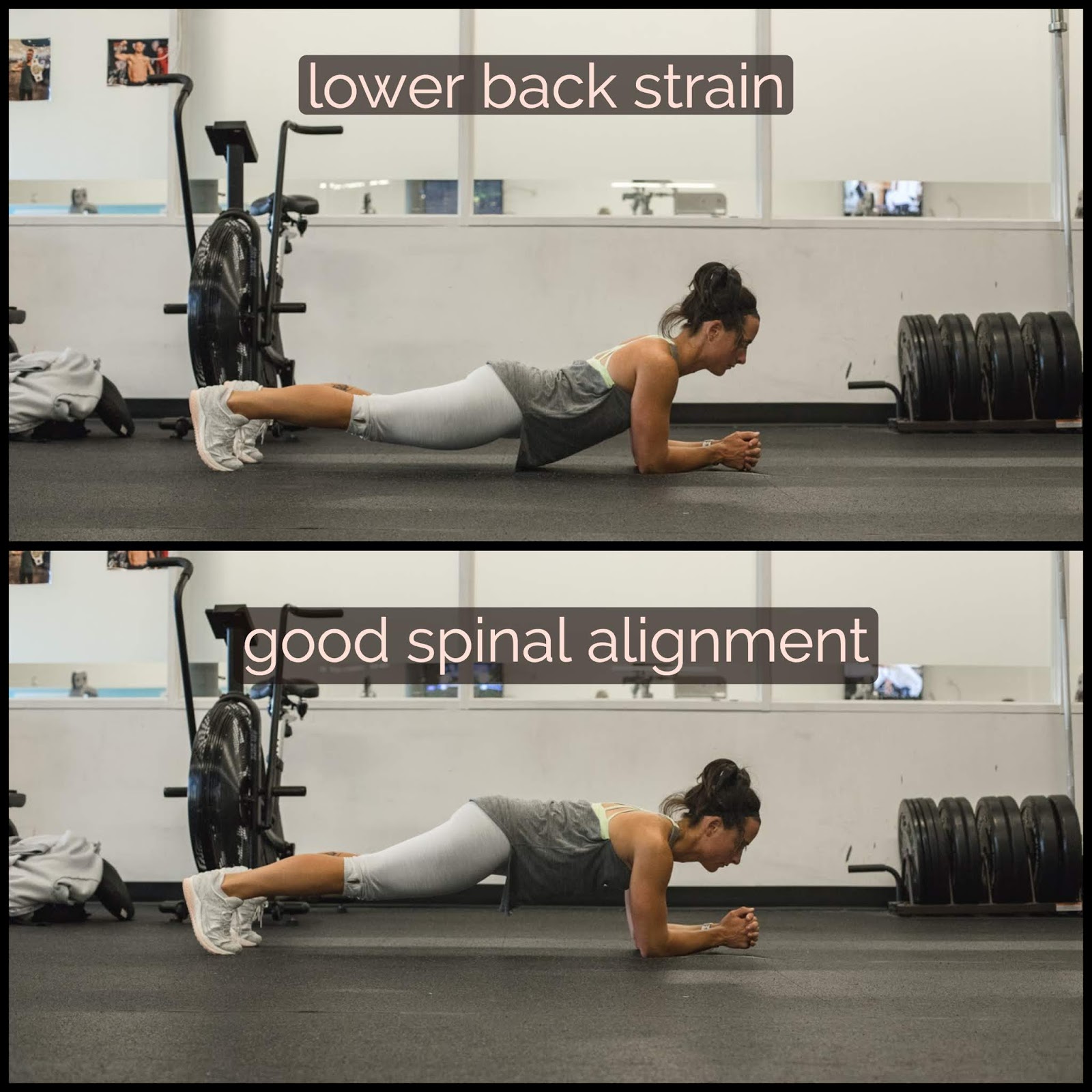
1. Plank: Lower Back Sinking Down: You probably know that sticking your butt up into the air is not the right way to do a plank, but be careful of your back sinking down too low as well. My favorite cue for this one is to engage your core by actively pulling your feet and your elbows towards each other as hard as you can. With this level of engagement, you might not be able to hold the plank as long, but you'll get more out of it. Make sure your elbows are directly under your shoulders too.
2. Calf Raises: Feet Rolling Laterally: This is a common mistake because rolling to the shorter toes on the outside of your foot is the path of least resistance. Your body will always try to take the easy way out when you're not paying attention. Focus on pressing through your big toe to engage your gastrocnemius (the big calf muscle). You'll also find that if you have trouble balancing on one leg, pressing evenly through all of your toes will help solve that problem.
3. Overhead Press: Arching Back to Push Heavier Weight: You might be doing this because your body has convinced you that it's a good way to lift heavier, or you might lack the shoulder mobility necessary to do an overhead press. Either way, save your lumbar spine and don't do it! Stabilize your lower back to the bench by engaging your core.
4. Squat: Body weight shifts forward, into toes (rather than back, into heels): This picture is an exaggeration of body weight shifting forward. Your feet could be completely flat to the ground, with the majority of your weight in your toes, and that would still be wrong. Give your knees a break and activate your posterior chain by placing your weight in your heels. It should feel like you are sitting back into a chair. In fact, you can practice, by sitting back onto something until the right feeling sinks in.
5. Squat: Not squatting low enough: If you don't squat to at least a 90 degree bend in your knees, the force of the weight won't transfer from your knees to your hips. This range of motion is what allows activation of the glutes, and takes the stress away from your knees. Don't forget to brace your core!
7. Pushups (or anything in the prone position): Straining your neck to look forward: It seems natural to look forward, but not only are you putting unnecessary stress in your neck, you're closing the neural transmission along your spine that allows your brain to communicate with your muscles. Focus your gaze to the ground for better results.
With triathlon coaching, most of my exercise prescription is done online, and I have to be able to trust that my athletes will do their strength training with the correct form, that they can determine the appropriate rate of increasing load, and that they know the difference between a hard exercise and an exercise that may hurt them. Even though I'll continue to lose sleep over this, I've started a list of common strength training technique mistakes that I've noticed over time. This list is by no means all-inclusive, but it's at least a starting point to make sure you're preventing injuries or imbalances that could be caused by these simple mistakes.
1. Plank: Lower Back Sinking Down: You probably know that sticking your butt up into the air is not the right way to do a plank, but be careful of your back sinking down too low as well. My favorite cue for this one is to engage your core by actively pulling your feet and your elbows towards each other as hard as you can. With this level of engagement, you might not be able to hold the plank as long, but you'll get more out of it. Make sure your elbows are directly under your shoulders too.
2. Calf Raises: Feet Rolling Laterally: This is a common mistake because rolling to the shorter toes on the outside of your foot is the path of least resistance. Your body will always try to take the easy way out when you're not paying attention. Focus on pressing through your big toe to engage your gastrocnemius (the big calf muscle). You'll also find that if you have trouble balancing on one leg, pressing evenly through all of your toes will help solve that problem.
3. Overhead Press: Arching Back to Push Heavier Weight: You might be doing this because your body has convinced you that it's a good way to lift heavier, or you might lack the shoulder mobility necessary to do an overhead press. Either way, save your lumbar spine and don't do it! Stabilize your lower back to the bench by engaging your core.
4. Squat: Body weight shifts forward, into toes (rather than back, into heels): This picture is an exaggeration of body weight shifting forward. Your feet could be completely flat to the ground, with the majority of your weight in your toes, and that would still be wrong. Give your knees a break and activate your posterior chain by placing your weight in your heels. It should feel like you are sitting back into a chair. In fact, you can practice, by sitting back onto something until the right feeling sinks in.
5. Squat: Not squatting low enough: If you don't squat to at least a 90 degree bend in your knees, the force of the weight won't transfer from your knees to your hips. This range of motion is what allows activation of the glutes, and takes the stress away from your knees. Don't forget to brace your core!
6. Deadlift: Rounding your back: I don't even have a "wrong" picture for this one because it hurts my strength-coaching soul to even replicate. Your spine has a natural curve that you should maintain when you deadlift, but don't excessively round your spine to pick up the weight. Engage your lats and your core, and let your legs actually help you do the lift.
7. Pushups (or anything in the prone position): Straining your neck to look forward: It seems natural to look forward, but not only are you putting unnecessary stress in your neck, you're closing the neural transmission along your spine that allows your brain to communicate with your muscles. Focus your gaze to the ground for better results.
Wednesday, October 17, 2018
Hard Work as a Crutch
If you're a long course triathlete, hard work is the nature of your sport. In contrast, sports such as baseball or golf are primarily skill-based sports, while endurance sports are on the other end of the spectrum, with fitness taking precedence over skill.
When you're a beginner, and you first start working hard at triathlon, you see results. Then you work a little bit harder, and you see more results. So we begin to train our brain that hard work is the key to improvement. Additionally, if you experience any level of success, the coinciding mindset is that more success is better; therefore, more work is better because it will lead to more success. The problem is, eventually this curve evens out and there's a limit to how much hard work we can actually benefit from before we start doing more harm than good.
Aside from the general nature of triathlon and beginner mentalities, what I believe limits our long-term success more than anything else is using hard work as a crutch, born out of insecurity. The first cause of insecurity is comparing yourself and your training to others. You see other people doing more so you become insecure about what you're doing and stop listening to your body. You might compare your training plan to your friend's, who is doing the same race as you, and you start adding in arbitrary extra workouts that have no focus, and only add to your overall fatigue. You might compare your speed in training to your competitors' and start doing your aerobic workouts too hard, which decreases your ability to do your speed workouts fast enough to actually build speed, and you dig yourself into a hole.
The second cause of insecurity is a negative response to falling short of a goal. When you come off a race where you expected to see a certain result, you resolve to work harder either as a self-imposed punishment for your lack of results, or out of fear of repeating that performance. When your training becomes a result of a fear-based mindset, your focus shifts away from your perceived exertion and from the cues that your body is giving you regarding your response to training stressors. Losing the connection to your physiological cues and effort level decreases your ability to pace yourself in both training and races, and limits your ability to build fitness at the most appropriate rate for your body. As you become more fit, the trend should be less effort (input) at the same pace (output). If you cannot objectively observe your internal responses to pace or power, you have no way to determine if your RPE is decreasing for that given pace or power.
So how do you go about fixing this problem? You have to be confident in your connection to your body, and be objectively dialed in to your perceived exertion and fatigue.
First, develop RPE. Every sport goes through a phase where technology and data evolve more rapidly than our ability to develop relationships with them. In triathlon, we get hooked on our fitness level and we drive ourselves crazy watching our CTL fall during recovery periods. We want to brag about our FTP, and our VO2 max, and show everyone on Strava that we are the kings and queens of that hill segment. But since the path to fitness is less effort at a given pace or power, if we are on an unending quest to prove ourselves through our numbers, we lose touch with developing actual fitness that can be expressed in racing. There are no ideal, one-size-fits-all fitness markers that equate to success. The best athletes know exactly how to push their body right up to their current physiological limits, then back off, recover, and let the body absorb fitness. If the focus becomes proving yourself in training and attaining the highest fitness number, you've shifted your goal away from expressing your fitness in a race.
The need to prove yourself in training is born out of insecurity, so the next step is to figure out the cause of your insecurity. You may not trust your coach, or yourself. Are you afraid of failure? Afraid of success? Think about what would happen if you "failed" (whatever your definition of failure is). Write down the worst case scenarios, and then you might notice that these scenarios are either not that bad, or not realistic. Being afraid of success might be more difficult to admit. It's possible that you don't think you deserve to be successful. List the athletes that you believe to be successful and write about their positive qualities. Then write down your positive qualities. Do you have anything in common with these athletes? I think it's important to visualize your success and consider what stories you want to be able to tell in the future when asked about a race, or a season, or a career. Maybe you want to be able to tell stories of overcoming odds, incredible discipline, or spreading inspiration. When you can visualize your goals, you get a more clear understanding of how to reach those goals, and better focus and attention to detail in your day-to-day training. With a clear focus, you don't need a crutch, and you become a more resilient athlete and person.
When you're a beginner, and you first start working hard at triathlon, you see results. Then you work a little bit harder, and you see more results. So we begin to train our brain that hard work is the key to improvement. Additionally, if you experience any level of success, the coinciding mindset is that more success is better; therefore, more work is better because it will lead to more success. The problem is, eventually this curve evens out and there's a limit to how much hard work we can actually benefit from before we start doing more harm than good.
Aside from the general nature of triathlon and beginner mentalities, what I believe limits our long-term success more than anything else is using hard work as a crutch, born out of insecurity. The first cause of insecurity is comparing yourself and your training to others. You see other people doing more so you become insecure about what you're doing and stop listening to your body. You might compare your training plan to your friend's, who is doing the same race as you, and you start adding in arbitrary extra workouts that have no focus, and only add to your overall fatigue. You might compare your speed in training to your competitors' and start doing your aerobic workouts too hard, which decreases your ability to do your speed workouts fast enough to actually build speed, and you dig yourself into a hole.
The second cause of insecurity is a negative response to falling short of a goal. When you come off a race where you expected to see a certain result, you resolve to work harder either as a self-imposed punishment for your lack of results, or out of fear of repeating that performance. When your training becomes a result of a fear-based mindset, your focus shifts away from your perceived exertion and from the cues that your body is giving you regarding your response to training stressors. Losing the connection to your physiological cues and effort level decreases your ability to pace yourself in both training and races, and limits your ability to build fitness at the most appropriate rate for your body. As you become more fit, the trend should be less effort (input) at the same pace (output). If you cannot objectively observe your internal responses to pace or power, you have no way to determine if your RPE is decreasing for that given pace or power.
So how do you go about fixing this problem? You have to be confident in your connection to your body, and be objectively dialed in to your perceived exertion and fatigue.
First, develop RPE. Every sport goes through a phase where technology and data evolve more rapidly than our ability to develop relationships with them. In triathlon, we get hooked on our fitness level and we drive ourselves crazy watching our CTL fall during recovery periods. We want to brag about our FTP, and our VO2 max, and show everyone on Strava that we are the kings and queens of that hill segment. But since the path to fitness is less effort at a given pace or power, if we are on an unending quest to prove ourselves through our numbers, we lose touch with developing actual fitness that can be expressed in racing. There are no ideal, one-size-fits-all fitness markers that equate to success. The best athletes know exactly how to push their body right up to their current physiological limits, then back off, recover, and let the body absorb fitness. If the focus becomes proving yourself in training and attaining the highest fitness number, you've shifted your goal away from expressing your fitness in a race.
The need to prove yourself in training is born out of insecurity, so the next step is to figure out the cause of your insecurity. You may not trust your coach, or yourself. Are you afraid of failure? Afraid of success? Think about what would happen if you "failed" (whatever your definition of failure is). Write down the worst case scenarios, and then you might notice that these scenarios are either not that bad, or not realistic. Being afraid of success might be more difficult to admit. It's possible that you don't think you deserve to be successful. List the athletes that you believe to be successful and write about their positive qualities. Then write down your positive qualities. Do you have anything in common with these athletes? I think it's important to visualize your success and consider what stories you want to be able to tell in the future when asked about a race, or a season, or a career. Maybe you want to be able to tell stories of overcoming odds, incredible discipline, or spreading inspiration. When you can visualize your goals, you get a more clear understanding of how to reach those goals, and better focus and attention to detail in your day-to-day training. With a clear focus, you don't need a crutch, and you become a more resilient athlete and person.
Wednesday, October 3, 2018
Ironman Chattanooga Race Report
I found out on the plane on the way to Chattanooga that the swim was canceled due to flooding and high levels of bacteria in the river. I think I may have some pre-ironman-flight PTSD because 3 years ago, I found out that Ironman Maryland (what would have been my first ironman) was canceled on the plane on the way there. I'm already in a tapering/emotionally unstable state, so I didn't handle this well at first. When Ryan looked over and saw my face, he asked me if I was ok. I let out a few words that might have formed a sentence if they were arranged in a logical order, but I'm pretty sure I at least included both, "swim" and "canceled," so he got the idea.
I typically swim about an hour for the 2.4 mile ironman distance, which puts me in the front of the pack heading out onto the bike. In my pre-race
So I proceeded to throw a pity party for myself, complete with some F words and some crying.
Then the next morning, I got up, put on my big-boy pants, re-wrote my race plan, and focused on what I always tell my athletes- control the controllables. I couldn't fix the swim problem, so I wasn't going to waste any more energy on being upset about it. I sent my athletes an email because I wanted them to be with me through this, so that they could be stronger than me and skip right over the pity party step, when something out of their control happens to them in a race. I had to acknowledge that this situation didn't change my goals, so I had to change my mindset. I wasn't going to let an opportunity to qualify for Kona pass me by because I was too busy feeling sorry for myself.
| Pre-race team visualization |
On race morning, we lined up for our time trial bike start, and I was all in. I've had a few significant opportunities to learn from my mistakes, with regards to nutrition, hydration, pacing, and execution, and I was determined to get it right this time. I know to the milligram the amount of electrolytes I'm supposed to be taking in, to the milliliter how much fluid, and exactly what my power output should be to give me the best chance to run off the bike.... blah blah data blah blah. I'm so dialed in on data for my athletes, but when it comes to my own performance, I can't be bothered by it. However, having this information available to me, makes me better able to focus on guiding my performance by feel. I follow the numbers in training, then use them as a loose guideline in a race. When it comes down making performance decisions, I listen to my body 100%.
| When your quad is trying to bust out of your shorts... |
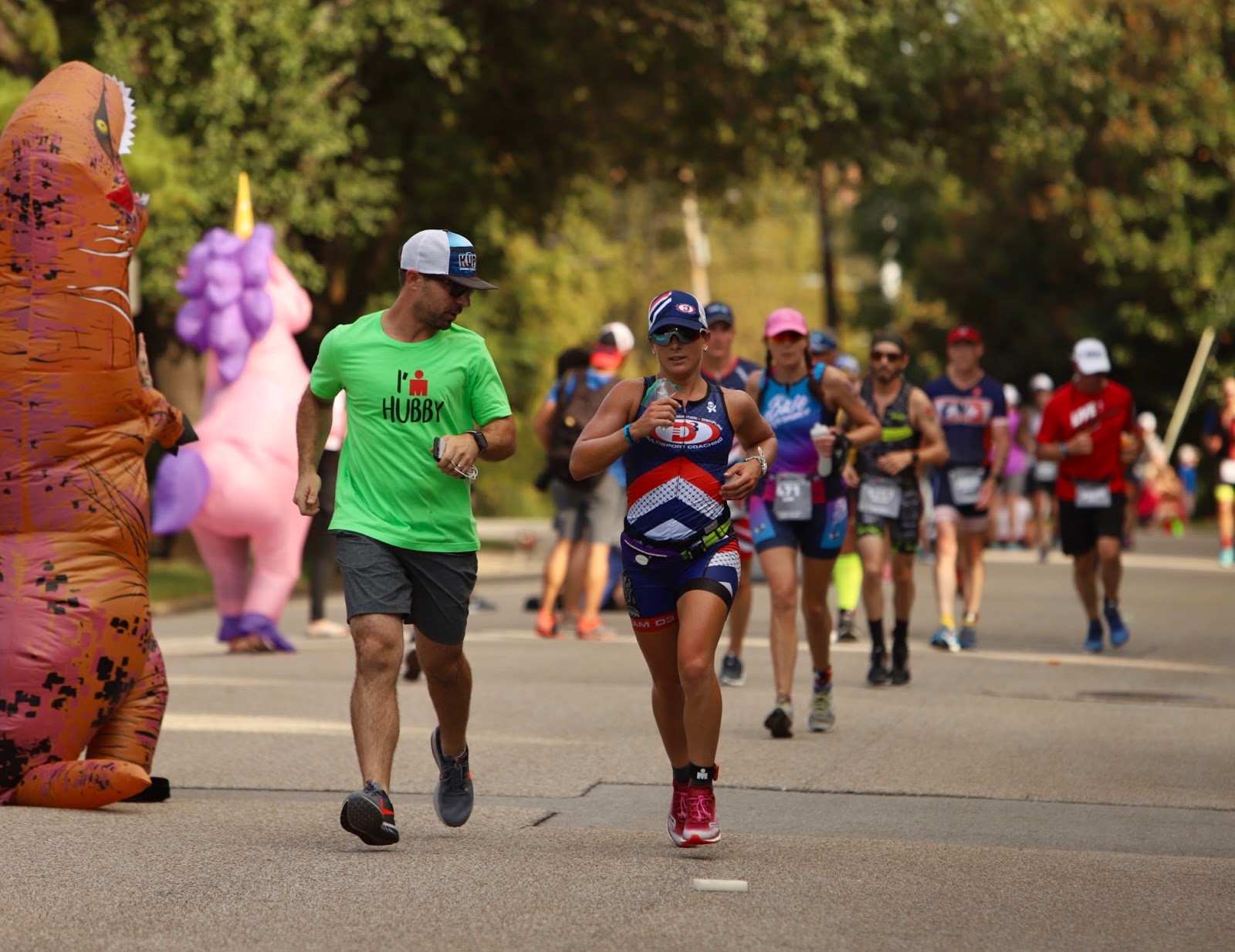
While only glancing at my power periodically, I finished the bike leg at the exact wattage I needed to ride at, and 303 TSS. I knew there were a few girls in front of me because they started first and I never saw them, and I knew there were a couple girls right on my tail as well. I'm not used to any of my competition being behind me getting off the bike so I wasn't sure what to make of that. But either way, I felt good getting off the bike and was slightly distracted by some weirdo running next to me in a cowboy costume yelling things like, "I'll see you in 3 shakes of a goat's tail." I asked around to see if that could have been someone else's husband, but no one claimed him, and he started yelling that he belonged to me for everyone to hear.
| Stage 1 of costume changes |
At this point, Ryan was on phase 2 of his pre-planned costume changes. The first stage involved a cowboy hat and a whip. I didn't ask him how far in advance he started planning his ironman spectating performance, but it was long enough to give him time to research cowboy sayings, so we'll just leave it at that.
| Fully invested |
Every time I went down an out-and-back portion of the run, I could see that I had some competition right behind me. This is the first ironman, probably because of the duathlon format, that I actually felt like I was in a race the entire time. That takes a lot more mental energy to stay focused, which is an experience that I'm glad I have under my belt now. The last 8ish miles of the marathon are hilly and I could feel my body wanting to slow down, but I knew I was somewhere near the edge of the podium, and I wasn't about to give that up. Then around mile 23, the girl who had been on my ass all day (who is now my new friend and potential training partner), ran up next to me out of an aid station and that was all I needed to turn it on.
![]() |
| Ryan put the costumes aside at the end of the race to let me know it was go-time. |
I put myself in the exact situation that I visualized and I was ready to go. I started running as hard as I could up that hill, thinking that I wasn't sure if I could maintain that pace, but I was determined to find out. My legs were on fire, but they weren't slowing down. Somehow, my last 3 miles of the marathon were my fastest 3 miles, and I ended up finishing on the podium, in 4th, and in a whole lot of pain (aka happiness).
The 1st and 2nd place girls took the Kona spots. I know it would have been different if the swim wasn't canceled, but I had no business placing on the podium in a duathlon and I was proud of the way I handled the race mentally, and how well I executed physically. And now that I know I can run that fast at the end of a marathon, next time I get to go even faster.
I have to give a shout out to my coach, Mike, who has to put up with a whole lot of my bullshit. I definitely don't make his job easy, and he probably breaks out in hives every time I tell him that I ignore my power meter, and only use my race plan as a loose guideline. We're on year 3 as a team, and we've both had to adjust our methods a bit, but the progress is undeniable.
I hope I tell them this enough, but I am endlessly inspired by my athletes. I get to watch them fearlessly fight for their goals, each in their own unique way. Whenever I'm at a low in motivation or confidence, it's easy to look at what they're doing and let them pick me up.
And last but not least, it has to be obvious how perfect my husband is. On the surface, triathlon looks like an individual sport but it never has been for me. Ryan is just as invested in this as I am, and we are stronger, faster, and tougher as a team.
Wednesday, August 8, 2018
Mid Season Goal Review and Adjustments
We all have goals on our mind at the beginning of the season. The world is our oyster, and we're free to pick any race we want, set any goals we want, and dream as big as we can. I challenge my athletes at the beginning of every season to set systematic goals.
It's easy to get excited about your outcome goals, which are the end results of your effort, like winning your age group, or qualifying for a world championship. The problem with only setting outcome goals is that you don't have complete control over them. You might work your tush off, have the best race of your life, and still not achieve your outcome goals because someone else showed up that day and beat you.
So the next step is to set performance goals. You have much more control over your performance goals than you do over your outcome goals because they don't rely on other people. How you perform is entirely individual. Examples of these goals are running 8:00 pace in a half marathon, finishing an ironman, or increasing your FTP (functional threshold power) to x watts.
Finally, the steps you take to get to your performance goals, are your process goals. You have complete control over your process goals because they are your actions; they are the day-to-day, week-to-week methods that allow you to create accountability for yourself.
So let's say that you did your homework at the beginning of the year, and set appropriate goals. That was the easy part. Now that you're about midway through your season, it's time to review your goals and make adjustments. Even if you've somehow managed to avoid all life stresses and unpredictability, chances are there are still some things you can do to improve.
The three general categories of adjustments I'm going to outline are a) you haven't made as much progress towards your goals as you outlined a the beginning of the season; b) you've already exceeded your goals for the season; and c) you're right on track to complete your goals as planned.
You haven't made as much progress towards the goals you outlined at the beginning of the season:
First of all, don't stress. If you find yourself in this category, and you've followed through with your process goals, you simply either have to lower your outcome and performance goals, or increase/adjust your process goals. Add in an additional day of strength training per week. Bump yourself up into a faster lane in your masters group. Go to bed 30 minutes earlier. The most important factor for this category is to be honest about what you've been doing that feels comfortable, and then get uncomfortable.
You've already exceeded your goals for the season:
Great job! It feels good to be ahead of schedule. The challenge for this group is to not get complacent. In order to have gotten yourself into this category, you either set appropriate goals given the information you had at the time, and pushed yourself really hard, or your goals were too conservative.
No matter how you got here, making adjustments in the only way to keep making progress. Your process goals are working, so you need to set higher performance and outcome goals. If you have a tendency to set conservative, easily reachable goals, you may be holding yourself back. Don't be afraid of failure. Challenge yourself to set your next round of goals 5-10% higher than where you would normally set them. Give yourself the opportunity to reach new limits.
You're right on track to complete your goals as planned:
Congratulations! Not only did you set appropriate goals, but you've stayed committed to the process. If you've done everything right to get here, staying focused and committed is already something you've proven capable of, so your challenge is to keep going.
However, being right on track with your goals is not always an indication that you don't need to make adjustments. This category can be the most challenging because it's not clear what kind of adjustments you can make. You're doing everything well, but what could you be doing better? There is always something to learn, whether it's about training, new technology, or something about yourself. The most successful athletes in any sport are constantly trying to figure out how to get ahead of the game, rather than just following along.
Be honest.
In evaluating which category you're in, be honest about whether or not you have been consistent with your process goals. It's easy to look back and determine whether or not you've achieved your outcome goals- you either won the race or you didn't. It's also relatively straightforward to figure out if you've reached your performance goals. Did you run that 8:00 pace that you wanted? Did you fall short? Or did you blow that out of the water and run a 7:30 instead?
Process goals take a bit more digging, and a bit more humility to own up to. But it is impossible to determine their efficacy, and their alignment with your performance and outcome goals, if you only do them sometimes. Process goals are meant to be followed through with, all of the time.
So if you find yourself in a different category than you expected, and you haven't consistently followed through with your process goals, that's a great place to start. Practice your swim drills twice a week, get 8 hours of sleep every night, do your dynamic stretches before every run, or stay committed to strength training. Whatever your process goal is, make sure it's every day, every week, every time. Once you've checked that box, you can then make an accurate assessment of whether or not these process goals are systematically leading you in the right direction.
Tuesday, June 19, 2018
Coaching 1st Time Ironman Athletes
I've had the privilege of coaching multiple athletes through their first ironman, and it is absolutely one of my favorite things to do as a coach. What I've noticed, is that it doesn't matter what level the athlete is at, what their goals are for the race, how long they've been in the sport, etc. They all go through a very similar mental process, complete with emotional highs, lows, wanting to quit, feeling on top of the world, feeling not good enough, feeling tired, scared, overwhelmed, fat, tired, wondering why they still have to go to work while they're ironman training, being pretty sure they could qualify for Kona, pretty sure they're never going to finish, and again, tired. I'm almost at the point that I can predict how our phone calls are going to go based on where they are in training. One of the things that I always want them to know though, is that all of those feelings are universal and "normal" (normal for ironman athletes), even when it feels like they're going insane inside their own head. So this is blog post outlines a little bit about what that journey looks like, and what you should expect if you're thinking about signing up for your first ironman.
(The pictures interspersed throughout this post are random pictures of my athletes participating in Ironman Boulder 2018. Not all of them were first timers, but all of them are awesome. Photo credit to my sister: Gina Eichert.)
The first step is exciting: emptying your bank account on a race entry fee. The minute you press that button, you're committed to a journey that is going to change your life. Let's be honest, who actually buys the insurance for your entry fee? The subsequent thought process changes quickly to, "What the fuck did I get myself into," along with a mild stomach ache. Sometimes I'm already coaching athletes at this point, but sometimes this is when they realize they need a coach.
Hopefully you've signed up more than a few months out from the race, which gives us plenty of time to gradually build fitness. I also use these beginning weeks to figure out what makes them tick, what they really want out of this journey (whether they consciously know what that is or not), and how to keep them motivated. Usually the first few weeks are relatively easy so that they can start to figure out how ironman training is going to fit into their lives, and also so that I can trick them into thinking that it's not going to be that bad. Managing emotions starts early. Soul crushing is for later on.
Then we start to build. Remember when you used to have friends and spent your time relaxing on the weekends? Me neither. Now your bike is your friend, so hopefully you've named it and gotten a comfortable saddle.
Building aerobic fitness is priority #1, so we build to 3-4 hour rides on the weekends pretty quickly. Usually around this point, I start getting phone calls from athletes trying to figure out how they're going to be able to go to their friend's wedding or their family reunion, and still fit in their training. Those things didn't seem like a big deal a few months ago, but now you're training for an ironman and everything is overwhelming. Should you skip the wedding? Should you take off work? Personally, my favorite choice for myself is taking off work to do more training, but then you also have to consider how you're going to afford your next ironman. So many decisions to be made on so little brain power.


6 weeks out to 4 weeks out, aka- peak weeks: "Doubt:"
This is the most mentally challenging block, not surprisingly, because it is also the most physically challenging block. This is when you have to know your "why." Remember back in the beginning, when I was asking you all those nosey questions about your life, and your family, and what you've been through? This is where that comes in handy. Your body is capable of incredible things if you are mentally prepared to take it there. Most of us have at least considered this idea, in order to have signed up for an ironman and gotten this far into training for it, but this is where you have to dig deep.
The phone calls that I get in this block are typically filled with insecurity and fear. Your training has gotten to such a level that you are getting a taste of exactly how hard it is to do an ironman, and what you've come to realize, is that it's really fucking hard. It's scary because you've never done anything this difficult before and it's natural to doubt your ability to reach new limits. For me, this right here is the best part about being a coach. If I can give you even a little bit of confidence, I get to sit back and watch you do amazing things. I know that you, along with the small percentage of batty people on this planet (myself included) who at some point thought it was a good idea to do an ironman, have an underlying desire to prove to yourself that you are limitless. Figuring out why you want this is part of my journey with each individual athlete, but regardless of why, I know that it's there. It's what unites us as a community of ironmen (or insane people, whatever you want to call it). It is my responsibility and privilege to remind my athletes exactly how capable they are, and it is my hope that my belief in them will inspire them to believe in themselves and persevere.
They key workouts to log away for your race-day memory bank from this block are the opposite of what happened in the "overwhelmed" block. You have a big workout on your schedule, and you're determined to do it, but halfway through, your body has just had enough. You hurt, you're probably a little dehydrated, and you've just been going so hard for so long. There might be a brief period where you stop and feel bad for yourself, and maybe shed a few tears, but you've already learned how resilient your body is, so you are going to drag yourself through this thing, kicking and screaming, because you have an ironman to do, and nothing is going to get in your way. I don't have to tell you what a big deal this is. You know.
2-3 weeks out: "Re-awakened:"
We're starting to taper and you're beginning to feel like your old self again. I don't have kids but I can imagine it's similar to when your baby first starts sleeping through the night. You almost forgot what it's like to have full use of your brain, have time to clean your house, and show up for work with clean hair. It feels pretty damn good. But with this new brain capacity, comes space for realizing that your ironman is right around the corner, and you are just about out of time to build fitness for it. Everything that has to be done in order to become an ironman, has to have been done by now, and you have a whole lot of extra time on your hands to think about that. Which leads us to our next phase: "insanity."
RACE WEEK: "Insanity:"
Race week is here, whether you're ready or not. If I'm your coach, you're ready. You've trained, you've figured out what a special needs bag is, you've made your race plan, and nailed down your nutrition strategy. Now you're experiencing your first ironman taper, which feels a lot like schizophrenia, except that you're fully aware of your insanity. If you've never experienced this before, "taper," can be described as a state of mind comprised of the following thoughts and feelings: hungry, cranky, moody, happy, sad, nervous, tired, anxious, fat, injured, excited, constipated, and manic.
Race week is my last chance, as your coach, to let you know how awesome you are and how far you've come. You have one really hard day ahead of you, but you've endured months of hard days, and you've persevered. Your resilience is what will get you to the finish line. Race day is a celebration of your hard work, but that doesn't mean it's going to be any less difficult. The celebration is about the fact that you have had the strength and courage to get yourself to the start line, and that you're ready to experience all of the ensuing pain and suffering, without letting it stop you. You're about to be an IRONMAN.
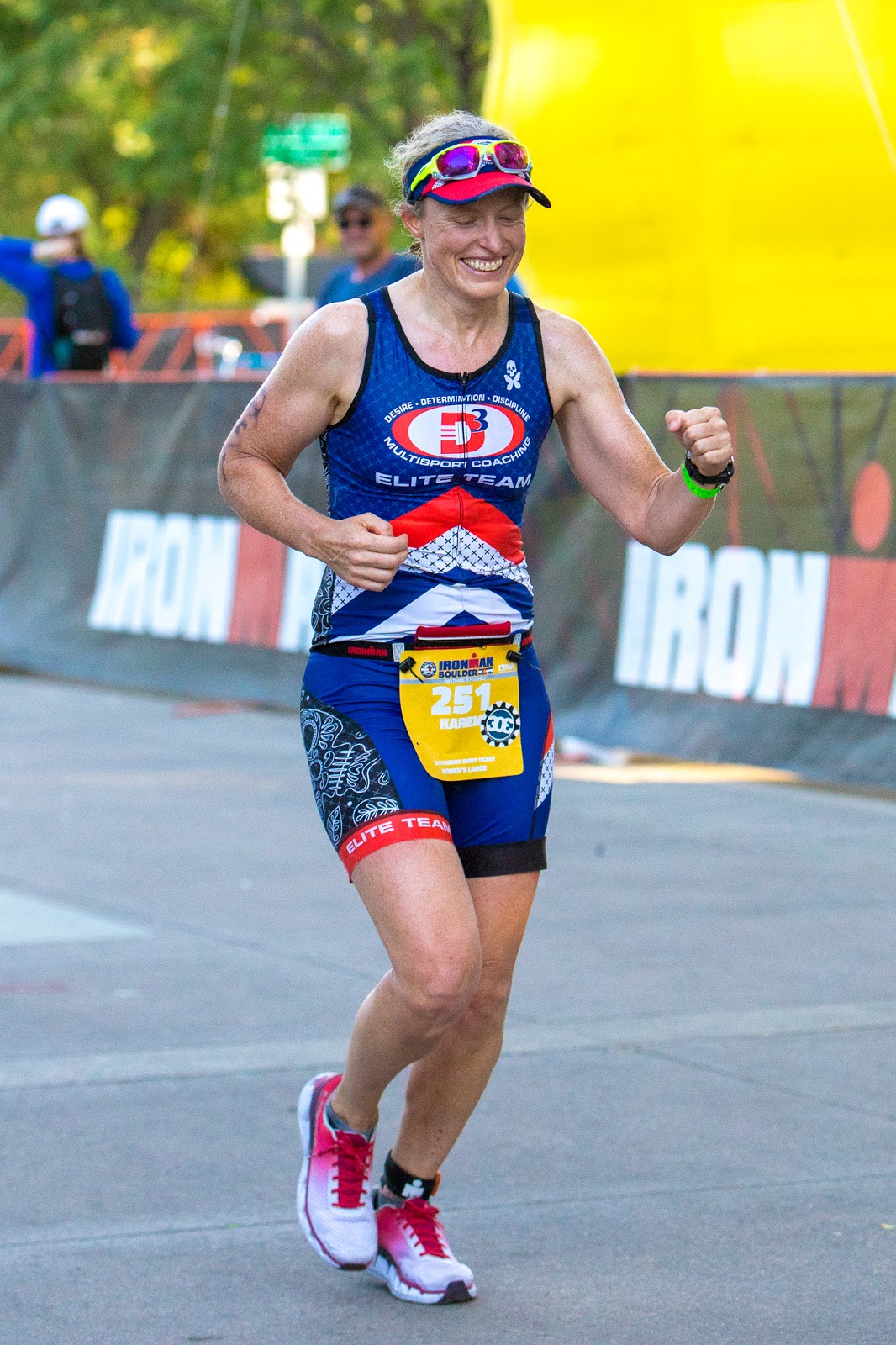
If you're still wondering if it will be worth it, these finish line pictures should convince you:

(The pictures interspersed throughout this post are random pictures of my athletes participating in Ironman Boulder 2018. Not all of them were first timers, but all of them are awesome. Photo credit to my sister: Gina Eichert.)
The first step is exciting: emptying your bank account on a race entry fee. The minute you press that button, you're committed to a journey that is going to change your life. Let's be honest, who actually buys the insurance for your entry fee? The subsequent thought process changes quickly to, "What the fuck did I get myself into," along with a mild stomach ache. Sometimes I'm already coaching athletes at this point, but sometimes this is when they realize they need a coach.
Hopefully you've signed up more than a few months out from the race, which gives us plenty of time to gradually build fitness. I also use these beginning weeks to figure out what makes them tick, what they really want out of this journey (whether they consciously know what that is or not), and how to keep them motivated. Usually the first few weeks are relatively easy so that they can start to figure out how ironman training is going to fit into their lives, and also so that I can trick them into thinking that it's not going to be that bad. Managing emotions starts early. Soul crushing is for later on.
Then we start to build. Remember when you used to have friends and spent your time relaxing on the weekends? Me neither. Now your bike is your friend, so hopefully you've named it and gotten a comfortable saddle.
Building aerobic fitness is priority #1, so we build to 3-4 hour rides on the weekends pretty quickly. Usually around this point, I start getting phone calls from athletes trying to figure out how they're going to be able to go to their friend's wedding or their family reunion, and still fit in their training. Those things didn't seem like a big deal a few months ago, but now you're training for an ironman and everything is overwhelming. Should you skip the wedding? Should you take off work? Personally, my favorite choice for myself is taking off work to do more training, but then you also have to consider how you're going to afford your next ironman. So many decisions to be made on so little brain power.

8 weeks out to 6 weeks out: "Overwhelmed:"
The ironman is approaching faster than you're comfortable with, and even though your body feels like it's falling apart, and you can't keep your eyes open at work, it seems like you're not doing enough. But also too much. It's confusing. All you know is you're tired, and you might want to cry a little bit.
One of the cool things that starts to happen around this time, is that there are always a few workouts where you get to really learn how tough you are. They go something like this: you're going into a workout thinking something like, "I can barely stand up straight. I don't know how my stupid coach thinks I'm going to be able to run." But you do it anyway, because it's on Training Peaks, and you always do what's on Training Peaks because a few weeks back, you stopped having the ability to think for yourself. And then something magical happens. Your legs have taken on this life of their own and they're actually running! And they're running kind of fast! You're not really sure what to do about this, so you just try not to question it, and let your legs do their thing. The lesson you need to hold onto from these workouts is that your body is incredibly strong, and usually it's stronger than your mind gives it credit for.
Don't give up, even when it feels impossible, because that is when the biggest breakthroughs happen.

6 weeks out to 4 weeks out, aka- peak weeks: "Doubt:"
This is the most mentally challenging block, not surprisingly, because it is also the most physically challenging block. This is when you have to know your "why." Remember back in the beginning, when I was asking you all those nosey questions about your life, and your family, and what you've been through? This is where that comes in handy. Your body is capable of incredible things if you are mentally prepared to take it there. Most of us have at least considered this idea, in order to have signed up for an ironman and gotten this far into training for it, but this is where you have to dig deep.
The phone calls that I get in this block are typically filled with insecurity and fear. Your training has gotten to such a level that you are getting a taste of exactly how hard it is to do an ironman, and what you've come to realize, is that it's really fucking hard. It's scary because you've never done anything this difficult before and it's natural to doubt your ability to reach new limits. For me, this right here is the best part about being a coach. If I can give you even a little bit of confidence, I get to sit back and watch you do amazing things. I know that you, along with the small percentage of batty people on this planet (myself included) who at some point thought it was a good idea to do an ironman, have an underlying desire to prove to yourself that you are limitless. Figuring out why you want this is part of my journey with each individual athlete, but regardless of why, I know that it's there. It's what unites us as a community of ironmen (or insane people, whatever you want to call it). It is my responsibility and privilege to remind my athletes exactly how capable they are, and it is my hope that my belief in them will inspire them to believe in themselves and persevere.
They key workouts to log away for your race-day memory bank from this block are the opposite of what happened in the "overwhelmed" block. You have a big workout on your schedule, and you're determined to do it, but halfway through, your body has just had enough. You hurt, you're probably a little dehydrated, and you've just been going so hard for so long. There might be a brief period where you stop and feel bad for yourself, and maybe shed a few tears, but you've already learned how resilient your body is, so you are going to drag yourself through this thing, kicking and screaming, because you have an ironman to do, and nothing is going to get in your way. I don't have to tell you what a big deal this is. You know.
2-3 weeks out: "Re-awakened:"
We're starting to taper and you're beginning to feel like your old self again. I don't have kids but I can imagine it's similar to when your baby first starts sleeping through the night. You almost forgot what it's like to have full use of your brain, have time to clean your house, and show up for work with clean hair. It feels pretty damn good. But with this new brain capacity, comes space for realizing that your ironman is right around the corner, and you are just about out of time to build fitness for it. Everything that has to be done in order to become an ironman, has to have been done by now, and you have a whole lot of extra time on your hands to think about that. Which leads us to our next phase: "insanity."
RACE WEEK: "Insanity:"
Race week is here, whether you're ready or not. If I'm your coach, you're ready. You've trained, you've figured out what a special needs bag is, you've made your race plan, and nailed down your nutrition strategy. Now you're experiencing your first ironman taper, which feels a lot like schizophrenia, except that you're fully aware of your insanity. If you've never experienced this before, "taper," can be described as a state of mind comprised of the following thoughts and feelings: hungry, cranky, moody, happy, sad, nervous, tired, anxious, fat, injured, excited, constipated, and manic.
Race week is my last chance, as your coach, to let you know how awesome you are and how far you've come. You have one really hard day ahead of you, but you've endured months of hard days, and you've persevered. Your resilience is what will get you to the finish line. Race day is a celebration of your hard work, but that doesn't mean it's going to be any less difficult. The celebration is about the fact that you have had the strength and courage to get yourself to the start line, and that you're ready to experience all of the ensuing pain and suffering, without letting it stop you. You're about to be an IRONMAN.
If you're still wondering if it will be worth it, these finish line pictures should convince you:
Monday, April 30, 2018
Ironman Texas Race Report
Ironman Texas was the first race post Korey Stringer, that I actually had my hydration plan figured out. I wasn't nervous about repeating the events of IM Los Cabos because I knew that Dr. Rob Huggins and the team at KSI had given me everything I needed to solve my bloating problem. I also felt confident that if it started happening again, that I would be able to correct it, and not continue to go downhill and end up in the medical tent, like before.
The Woodlands was an awesome race venue. I'd absolutely recommend it for an ironman, especially if you're looking for a PR. My support crew at this race was supposed to just be Ryan and my mother-in-law. However, the first night at dinner, my sister Heather showed up! If you guys don't know how awesome Heather is, just watch this video. She's the one dancing amongst the Wattie Ink crew with my 2 dog faces.
Then the next day, Gina showed up! If it was ever in question how much I love my sister, here's this:
And just when I thought that was all of the surprises, on our way to the race start in the morning, my brother Carl gets out of his car with the 2 giant dog face cut-outs that Ryan had made for me. I have to admit, I was excited to see Carl, but I was a little distracted by my cute dogs' faces on giant poster boards. I've always known that my dogs were meant to be famous, but it was funny to see all of the athletes and spectators wanting to take pictures with them on race morning.
The swim was ok. I thought I would be able to swim under an hour since I've been swimming so well in training recently but I came out with a 1:02. The swim is such a short portion of the race though, that I try not to let it bother me, and just focus on what's coming next. The second half of the swim course goes into a narrow canal where spectators can walk next to their swimmer (if they can find them in the masses), but Ryan always finds me, so I heard him cheering and out of the corner of my eye, I could see my dog faces, which made me really happy.

The Woodlands was an awesome race venue. I'd absolutely recommend it for an ironman, especially if you're looking for a PR. My support crew at this race was supposed to just be Ryan and my mother-in-law. However, the first night at dinner, my sister Heather showed up! If you guys don't know how awesome Heather is, just watch this video. She's the one dancing amongst the Wattie Ink crew with my 2 dog faces.
Then the next day, Gina showed up! If it was ever in question how much I love my sister, here's this:
And just when I thought that was all of the surprises, on our way to the race start in the morning, my brother Carl gets out of his car with the 2 giant dog face cut-outs that Ryan had made for me. I have to admit, I was excited to see Carl, but I was a little distracted by my cute dogs' faces on giant poster boards. I've always known that my dogs were meant to be famous, but it was funny to see all of the athletes and spectators wanting to take pictures with them on race morning.
The swim was ok. I thought I would be able to swim under an hour since I've been swimming so well in training recently but I came out with a 1:02. The swim is such a short portion of the race though, that I try not to let it bother me, and just focus on what's coming next. The second half of the swim course goes into a narrow canal where spectators can walk next to their swimmer (if they can find them in the masses), but Ryan always finds me, so I heard him cheering and out of the corner of my eye, I could see my dog faces, which made me really happy.
I hadn't done a flat bike course since my first ironman- IM Arizona in 2015. I knew I was due for a bike PR, but I didn't know I was capable of a 5:09 bike split. This is where I really started putting my new nutrition and hydration plan into place. I had it all worked out for the mid-80 degree day that it was supposed to be, but the first couple hours on the bike were actually still relatively cool, and I forgot to take this into account at first. I got a little bit bloated in the first hour, but then I made an adjustment, and was able to fix myself and decrease the bloating. I backed off the fluid, but still focused on taking my salt sticks, and getting the right amount of calories from the shot bloks I had with me and grabbing bananas at aid stations. Potassium is my biggest concern because that's the electrolyte that I tend to excrete at a higher rate, so even though I wasn't sure what kind of effect the bananas would have on my stomach, I knew I had to take them in anyway to correct my electrolyte balance.
Even though it was 2 loops out-and-back on the bike, I didn't get to see my crew halfway through because we stayed out on the highway. I was actually a little bit relieved about this because I didn't want them to see me bloated on the bike and get worried. I had it under control this time.
This is what my face looked like after my 5:09 bike split:
The run is my favorite part so I'm always excited to get off my bike. And I hadn't seen my crew in a while, and I missed them and their shenanigans.
Sometimes I write things in my race plan, like "don't go under 8:00 pace in the first 5k," and then blatantly ignore it. This was one of those times. I just felt good and my legs felt like they wanted to be fast so I let them. They weren't bloated so they wanted to celebrate. I felt pretty good the first 2 loops (out of 3), but I could tell that my stomach was upset about having to take in all those calories without fluid on the bike. I had a hard time getting anything else in my body from that point on, and I ended up puking most of the third loop. I didn't stop to puke though, just let it come right out in stride. I've kind of always wanted to do that, and it was just as cool as I thought it would be.
I knew I wasn't getting on the podium at that point, so I didn't let it bring me down. I just kept looking for my crew and kept a smile on my face.
After what I went through at Los Cabos, I'll never take an Ironman finish for granted. I thought I was capable of a 10:15 at this race, but I still had a few things to work out with my nutrition. Still, I knocked off 30 minutes from my Ironman PR, and it will never get old coming down the finish shoot and hearing Mike Reilly say, "YOU ARE AN IRONMAN!"
Being fast is important to me, but it's not the reason I do this. The best thing about being an ironman, is you get to continuously prove to yourself that you are capable of doing anything you want to do, if you work for it. And hearing my athletes and family and friends say that they're inspired by what I do, is everything.
Last but not least, I think it's pretty obvious what a great husband I have, but what he does behind the scenes for me is even more meaningful than what you get to see in pictures. Most of it we'll keep between the two of us, but my results on race day are the product his hard work and passion, just as much as mine.
Subscribe to:
Posts (Atom)
New Bio, who dis?
As I've witnessed myself shift and change, I've been experimenting with some new coaching strategies. Most of my athletes know that ...