Wednesday, June 12, 2019

Escape from Alcatraz Race Report


My focus for this season is on Ironman Canada. With Escape from Alcatraz being only 7 weeks before Canada, I wasn't going to make time to train specifically for that distance. I basically just used it as an excuse to do my favorite workout, which is running up and down the stairs at Red Rocks. I also knew it would be important to mix in some cold water acclimation, which I was less excited about. I can race in the heat with no problem, especially now that I have my fluid and sodium loss down to a science, but I am not interested in being cold. Ever.


So I started taking cold showers, and getting into cold water whenever I could, which was made possible by our long terrible winter. (Thanks, Colorado.) Every time I turned my shower head to the cold setting, it made me angry. I have no idea why I have such a high tolerance for doing things to myself that I dislike. One morning after a hail storm, I got into the outdoor pool at my gym, with the ice chunks. I thought I would just jump in and start swimming but after a few strokes of not being able to catch my breath, I had to stand up to get my lungs out of the water. Then I told myself that I was going to swim for 10 minutes and I was not going to feel cold, and that's exactly what I did. I was able to relax my body, and get it done. The problem was when I got out, I was really dizzy, and numb everywhere. This made me realize 2 things: I am grateful for my ability to put mind over matter and commit to whatever mental state I set my intentions on; and, mind over matter may not always be the best approach for me.

My new goal for Alcatraz would be focusing on the "matter," aka, tuning in to the feelings instead of overriding them. The next time I jump into a body of water with ice chunks, I would focus on the cold, and feeling it on each part of my body so that I could know when it would be appropriate to get out and not get hypothermia. In the race, I would tune in to each sensation, to have a better understanding of how to get the most out of myself, based on the feedback from my body. I've spent so much time completely ignoring pain and discomfort, that it seemed a little scary at first, but I was excited for the new challenge, and it felt like an important step in my development.


The boat we jumped off of (the San Francisco Belle) through Ryan's binoculars


Come race day, here are some of the things I got to feel:

1. Arguably my favorite part of the race: the pre-race boat ride out around Alcatraz with 2000+ other psychos who thought this would be a good idea. We were on the boat for about an hour without phones or anything else to distract us, and the energy was unlike anything I've ever been a part of.

2. The 3 seconds right before it was my turn to jump, my heart was in my throat, and I felt some combination of fear, nerves, excitement, and just the pure intensity of being alive.

3. The stinging of salt water in my eyes starting the second I jumped in, and all the way to shore. I wanted to be uncomfortable, right? Having my goggles turn into mini water bowls felt like it met that standard, so I decided to just keep swimming, instead of stopping to fix them. AND, now I didn't have to see any sharks if there were any.

4. Land, sweet land.

5. The excitement of the wild ride that was the bike course! If you have ever been to San Francisco, just imagine a bike course there.

6. Not being afraid of maxing out my effort up the steep grades, and being able to do it again and again.

7. Pure gratitude for disc brakes.

8. All of my hopes and dreams for running up the sand ladder, crashing to a complete halt on stair #2 out of 400.

9. The burning in my lungs the last few miles to the finish, reminding me how relieving it would feel to slow down just a little bit.

10. The satisfaction of not slowing down, and leaving it all out there.


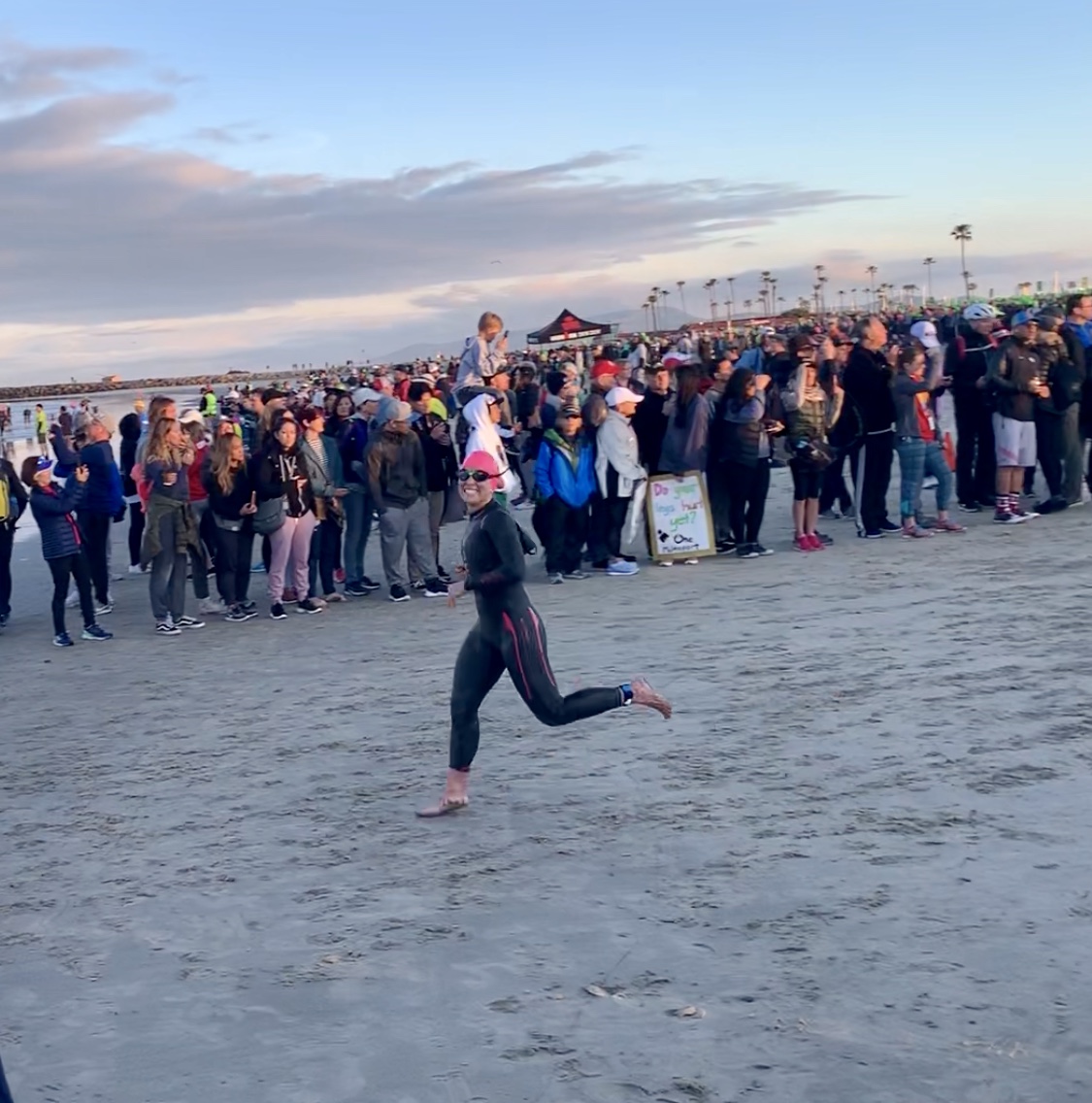
I had no idea what I was getting myself into when I signed up for this thing, but it was truly a bucket list race, and I'd recommend it to anyone looking to get outside of their comfort zone and have an absolute blast in a triathlon. I came in 2nd place in my age group and 8th overall female. I missed out on 1st place by less than the difference of our T1 times. If I could go back, I wouldn't have stopped to put on shoes before running the half mile to transition. But I can't go back, so whatever.


Focusing on the sensations of the race allowed me to be in the moment, which I know will come in handy when I need to occupy my mind throughout the course of an ironman. Even when my mental game has been at its best, I still have moments in every ironman where I'm worried about my competition, the conditions, and how there could possibly be SO MANY MILES LEFT. It also allowed me to make conscious decisions on the fly, about how to react to each situation. And most importantly, it made me realize that even if a sensation is negative in its connotation (i.e. pain, burning lungs, etc), I don't have to react negatively to it. I don't have to slow down. I just have to be aware.

So here we go, onward to Ironman Canada. In order to be successful, I'm going to need 100% of my focus on my own task, rather than what's happening around me. And I just got a lot better at focusing my attention on my goals.

Tuesday, April 9, 2019

Oceanside 70.3 Race Report

To start off, I'm already planning on going back to Oceanside next year. The course was beautiful and well-supported; Oceanside is a great host city... But most of all, we really want to drive the dogs out there so they can experience the beach. I'm pretty sure my non-swimming (yet not afraid of trying) husky is going to be quite the scene.

Look how cute they ride in the car together.
This was my first race coaching myself. I gave myself a few cutoffs for fucking up my training enough to need a coach, but I just kept rolling and making progress. I had a date in mid-February that I would make a decision about coaching myself through Oceanside, or needing to hire someone else. Then how well I raced at Oceanside would be my last chance to change course and hire someone before Ironman Canada. Luckily, I have a husband/therapist who keeps me from self-sabotaging, and regularly asks me tough, direct questions about what I'm doing with my life. About a month ago, we went through a line of questioning regarding what I would need to do in Oceanside to feel confident coaching myself moving forward. That's when I realized that the decision had already been made.

One of the many great things about Ryan is that he understands that my decision making process is completely opposite than his logical, strategic system. But he trusts me to do what's right for me, as long as I'm confident. Every important decision I've ever made is based completely on my intuition and my "feel." Coaching myself so far this year has allowed me to break through old patterns that no longer serve me, to look at my training from new angles, and to be even more tuned in to my body. I've made a lot of physical progress, but I've also had to make a lot of mental progress. I have to trust myself. I have to be completely aware of my mind and body at all times, without judgment. Aside from anything physical, growing in that area has, and will continue, to make me an infinitely better athlete.

So I'm all in for this year. I'm committed and I'm ready to get back to the World Championship, on the island that I love so much I tattooed it on my body.


My race plan had a completely different structure than it has in the past. Instead of mapping out my splits in terms of power and pace, breaking down my nutrition into hourly calories, fluid ounces, and electrolytes, my new race plan style consists mostly of mantras, gratitude, and mental themes. Sure, there are some course details to keep in mind and some basic ideas about speed and time goals. Don't get me wrong, I only feel comfortable making my race plan this way because I have a wealth of knowledge regarding my power and pace, and some handy experience with hyponatremia that led me to find out EXACTLY what I lose per hour in fluid ounces, and each individual electrolyte. What I have learned throughout these experiences though, is that if I'm completely tuned in, I know exactly what my body needs, and what it can sustain, moment to moment.

Here's an excerpt from my race plan:

"I am in this with my body. I learn best through trusting my body and letting it guide me, instead of trying to get in it's way or deny what it's trying to tell me. My body is strong and resilient, and I want to be completely tuned in to it's strength."


Swim: 33:04

I was excited about the ocean swim. I've had some good ocean swims in past races, including my only sub-hour Ironman swim. I decided ahead of time that I wasn't going to be cold. I'm gaining confidence in the fact that I have control over the way I respond to every situation, and that expectations are met at whatever level you set them to be met. "Cold" is subjective, so I simply didn't expect to be cold.   

As soon as it was my turn to step up to the start line, I got that giddy race feeling and giggled like a little kid the whole way into the water.

 
I think I could have done a better job swimming through/under the waves on the way out. I caught myself a few times getting held up and basically swimming in place, not making any forward progress. Once we hit the first turn buoy, I got into a solid rhythm and felt strong, but I think I costed myself some time on the way out. I typically swim right around 30 minutes for a 1.2 mile swim, so I was a little disappointed to see 33 on my watch. But I never let myself feel negatively about a swim in the moment because there's still so much racing to do. Sometimes I don't even check my time.


Bike: 2:57:31

The winter in Colorado this year has been extra wintery, so I didn't have many outdoor rides under my belt going into this. Even as I type this, we're supposed to get another snow storm tomorrow.  I recognized that that was one of my shortcomings in training leading up to this race. I did, however, put in a lot of hard efforts on the trainer. My peak power is higher than it has been, so I definitely wasn't worried about hills. And that's pretty much how it panned out. I felt like I could fly up hills but didn't have much ability to sustain power. That will come. I'm planning on all but living on my bike in the mountains leading up to IM Canada. So that being said, my time was "meh."

I don't have the same problem as I do after the swim, trying to avoid letting my time get in my head, because I'm just too excited to get the F off my bike and run. 


Run: 1:37:29

I know I'm not alone in this thought, but if I have a good run, I'm generally happy with my race, no matter what else happened. Running is my favorite in the exact same way that smiling is Buddy the Elf's favorite. My primary goal for this run was to get into the zone, and be completely immersed in the moment. I'm certainly not recommending this pacing strategy, but it was important for me to not be worried about the future. Meaning, I wasn't going to anticipate any pain or slowing down at the end. I was just going to go hard.

I averaged under 7:30/mile, and my splits were pretty consistent throughout the entire half marathon. I'm really happy with how well I ran, but it only proves to me that I have a lot more speed to unlock.

Overall, I'm leaving Oceanside even more assured that I'm on the right track. I know exactly what I have to do to give myself the best chance of standing on top of the podium in Whistler. And I wish this damn recovery week would end so I could get to it.


Tuesday, February 19, 2019

Coaching Myself: Part 3

I honestly didn't think there would be a "Part 3" on coaching myself. I thought for sure Ryan would have thrown me into the looney bin by now and/or begged someone else to coach me. One of the reasons I decided to make this change was that I felt like I needed a hard reset on some of the patterns I had gotten myself into that weren't helping my growth. I expected to hit that reset button with coaching myself for a couple months, but then assumed that I'd go off the deep end and need to hire a new coach by the end of February (that was my pre-determined cut-off). Much to my surprise, things are actually going better than expected.

My sister, Gina, is just so good at photography.

One of the biggest contributors to my sustained sanity, and dare I say, improved fitness, is my shortened and intensified build/recovery schedule. I began by tracking my HRV (heart rate variability) daily to incorporate an objective measure of my fatigue and recovery rate, rather than relying completely on feel. My cycles have been: build for 2 weeks, recover for 4 days. The key here is that I've been able to increase my intensity in those 2 weeks because I'm recovering harder. My workouts in those 4 recovery days include yoga and basically just floating around in the pool. I don't run at all, which is hard for me since running is my favorite. I can't say that I'm mature enough to take full days off yet (baby steps), but I'm not ruling it out for the future.


I made more strength gains in the weight room this off-season than I have in years, and I'm committed to learning more and being more focused on nutrition. I've also been tracking my monthly cycle and applying my newly acquired knowledge from Dr. Stacy Sims' book, "Roar," to make sure I'm working with my physiology to do what's best for my body. If you don't like to hear about periods, go ahead and skip the rest of this paragraph. I have an IUD, which means I don't actually get my period, but I do get all of the other symptoms and have the same hormone highs and lows throughout the month. Without the obvious monthly cue, I had to start with tracking my symptoms as I noticed them, and it took me no time to figure out when my high hormone phase started, with my scientifically coined markers such as "feel fat" and "want chocolate." From there, I've been capitalizing on the low hormone part of my cycle, and making sure that I'm supporting my body with the right nutrition and supplements for the high hormone part.

I don't know how my first race of the season, 70.3 Oceanside, is less than 2 months away already, but I'm excited to put this all to the test. I've never coached myself through a big race, and I'm actually just realizing that right now as I'm typing this... which is mildly anxiety-inducing, even though I was just bragging about how well I think I'm doing.


Whatever. Can't be totally sane to do this sport.

...I wonder what my race plan will look like.

Wednesday, January 9, 2019

Coaching Myself Part II

In "Coaching Myself Part I," I said that I was going to ask myself if I did my best each week. Turns out that is HARD to do. Maybe I shouldn't have started it right before the holidays, but even into January, I'm having a hard time with it. On the weeks where I know I didn't do my best (even though they were during Christmas and when I was sick for a week), I could not get myself to actually write down that I did not do my best. I thought about it, tried to rationalize it, stared at my notebook for a while, but never actually wrote down the word, "no." For the weeks where I'm on the fence about what my best was, I've had to do a lot of soul searching to figure out what my best even means.

I'm not quite sure what kind of psychological issues we're dealing with here, but I'm not giving up on this one. I'm not going to continue to shy away from things that make me uncomfortable, especially when they stand in the way of my progress. The funny thing about triathletes, is that on the surface, it looks like we do uncomfortable stuff all the time. I'll only speak for myself, but I think I've gotten relatively comfortable doing hard workouts, to the point where my current incremental progress is due primarily to consistency (not to be undervalued), rather than finding ways to dig deeper than I do on a regular basis. This would all be well and good if it matched my goals. Let's say my goals were to get a 15 minute Ironman PR and get back on the podium, like I did in 2018. I could probably accomplish these things by continuing to do what I'm doing, but that's not why I'm here.


This was right after finishing my first ever triathlon (check out my kit), back when everything was hard, every time
.... including shaping my eyebrows, apparently.

When I first got started in triathlon, I didn't even know what a comfort zone was. I had just graduated from UConn and my favorite part of playing college lacrosse was our strength and conditioning workouts. I had a weird masochistic obsession with pushing my body as hard as it could possibly go, then being told to do it again, and somehow finding more in the tank. (If any of my teammates are reading this, yes- I know I was the only one who liked that.) So I've decided that I need to hit reset on my current routines and get back to that mindset.

I have 2 themes that I'm focused on for 2019. They apply to all aspects of my life, and I haven't figured out all of the specifics for some areas, but I know exactly how they apply to triathlon. They are:

1. Show Up

2. Stay Uncomfortable

They can be interchangeable at times and so far, they've mostly manifested as me cursing at myself under my breath when my alarm goes off earlier than I want it to, and I have to drag my ass to masters instead of doing my own swim at a more reasonable time of day. Showing up is about not making assumptions or having any expectations about a workout before it starts. If the workout is in my plan, I'm going to show up no matter how tired I am, and leave the door open to surprise myself with what I can accomplish.

Staying uncomfortable is the only way I'm going to make the progress that I want to make. Last weekend I went to the first of a group bike trainer series (that I prepaid for so I couldn't get out of it), and we worked on all of the exact things that I suck at. I've been ignoring working on cycling drills like ILT and high cadence because I've convinced myself that my time would be better spent just working on getting my power up. We spent the entire 2 hours doing both of those things to exhaustion, and while I'm pretty sure my average watts were around 7, I could barely lift my leg through the pedal stroke by the end.

And then I went running after that group trainer ride. 


Every year, I have my athletes fill out a goal sheet. Since I am currently enlisted on my athlete roster, I made myself fill one out as well. It was harder to fill out than I thought it would be, which I appreciate, because now I have a better understanding of the level of deep thinking and commitment that my athletes have to pull out of themselves when they put theirs together.

The goal sheet starts with the race schedule, and here is what I know of mine so far:

4/6: 70.3 Oceanside
6/9: Escape from Alcatraz
7/28: Ironman Canada

As it has been for the past few years, the second half of my season is left open for the chance that I qualify for Kona.

Aside from my themes, which apply to all levels of goals, the rest of the goal sheet looks like this:

Write your list of goals for the upcoming season, and split them into 3 categories:

Process goals: These are the goals that you have the most control over. What are you going to do in your training that is going to make you a better athlete? Example: be consistent with your strength training, spend x days per week in the pool.

  • Train more consistently with other people, especially people who are faster than me
  • Ride outside when I have the chance, rather than relying too much on my trainer
  • Stay focused on eating nutrient-dense food, rather than just paying attention to macronutrients
  • Meditate and journal regularly to stay connected to the roots of my motivation
  • Ask myself on a daily basis, "am I making the kinds of choices that someone who podiums in Kona would make?"

Performance goals: You have some control over these goals, especially if you line them up with your process goals? Example: raise your FTP to x
  • Run 1:35 off the bike in Oceanside
  • Run sub 3:40 off the bike in Whistler
  • Swim under an hour in Whistler
  • Get a new Ironman PR: sub 10:35

Outcome goals: These are not always under your control. You could have the outcome goal to win a race, and you could have the fastest time of your life, and still not win the race, depending on who else shows up. It’s still important to write them down so that you have something that you’re shooting for.   
  • Qualify for Kona
  • Podium in Oceanside
  • Podium in Alcatraz


If there was a goal that you didn’t reach last season, why did that happen? Were you too focused on outcome goals, and not enough on process goals? Were you consistent in your training, focus, and in your mental toughness?

Ever since I raced on the big island in 2016, it's been my goal to get back, and I did not accomplish that goal last season. Admittedly, I'm always more focused on my outcome goals but that doesn't mean I didn't follow through with my process goals and make a lot of performance improvements. I'm just competitive and I want to win more than anything else. That's what drives me to stick to my process goals. What I need to change is my inner dialogue.

Even though I was consistent with my training, I was not consistent with my mental commitment. I have a really hard time being fully invested in someone else's training plan (someone else being whoever my coach is). I always think I know better and I'm constantly questioning things, which more than anything else, wastes energy. The success of any plan is determined by the level of buy-in, and I've held myself back by not buying in. I needed this coaching change for 2019 because if I can't buy in to my own plan, then I'll never be able to move forward.

Monday, December 3, 2018

Keep it Simple, Stupid


"Simple can be harder than complex. You have to work hard to get your thinking clean to make it simple. But it's worth it in the end, because once you get there, you can move mountains."
- Steve Jobs


Media is so widespread and complex that athletes have access to almost any answer to any training related question they can think of, in both writing and video form. We spend hours scouring social media for training trends, flashy new technology, and basically anything the pro's are doing. If there is a quicker, more expensive way to get faster, we're going to find it, and pay for it. The stuff that get's the most "likes" is new and exciting, probably colorful, and definitely not simple.

The most simple guy I know; doesn't even own bike shorts.
The truth of the matter is, if you have chosen endurance sports as your game, you didn't pick anything flashy or complicated. You should have chosen basketball, where you can dribble the ball between your legs and dunk, and where those skills actually translate to the sport itself. But here you are, trying to distract yourself from the monotony that defines endurance. There's a reason why triathlon isn't a popular nationally televised sport. Triathlon, in it's essence, is simple. In my opinion, it is beautifully simple. We swim, we bike, and we run.

Fortunately for coaches, we have an incredible amount of data to utilize in order to coach you better, but most of it just makes up for the fact that we can't be with you in person for all of your workouts. If we were right next to you on that bike ride, we would see you hit those intervals, and we would know what kind of an effort you gave in order to hit them (which is arguably the more important piece). Since we can't be there, we see your power and heart rate files at those intervals, compare them to your threshold, and make a several assumptions about how you must have felt, if those intervals did the job that we thought they were going to do, and cross our fingers that your heart rate was an accurate representation of your effort, and not majorly affected by one of the millions of things that heart rate is affected by (heat, humidity, illness, sleep, stress, medication, glycogen, hydration, etc).

The more tools and forms of data that athletes have, and that coaches can utilize, absolutely gives coaches a better understanding of the athlete and their respective workouts. However, sometimes athletes can get caught up in the overwhelming amounts of resources that are available and lose sight of the simplicity of training. Sometimes results don't come as quickly as we would all like them to come, and the answer is almost never a missing piece of technology or a specific key workout. There's no secret or quick fix for success in triathlon. Success is achieved by consistently showing up, pushing yourself right up to the line of your current ability, recovering, and repeating that process over and over, getting better step-by-step, day-by-day. By the very nature of our sport, you must endure. Sure, you've heard this before. It's boring. You want to be fast now, and right after you're done reading this, you're going to read "6 Running Tricks to Make you Faster TOMORROW!" The problem with triathlon in our fast-paced world is that it requires patience.


Swimming on vacation; Objective: maintenance and fun

Therefore, if you are truly interested in longevity and sustainability in order to achieve your potential, it is important that you develop your connection to your sport, and the connection between your body and mind. When you've officially searched the entire internet for all of the secrets to getting faster tomorrow, and you've purchased all of the gadgets, it's important to have a clear understanding of what sustains you. After a certain amount of seasons chasing your triathlon goals, you'll inevitably gain the understanding that training with consistency and simplicity are the only keys to achievement over time.

If your goals are still worth fighting for, now that you know that there are no quick fixes, you will have to rely on your strengths to continue to persevere.

Rather than aiming for specific numbers, you should know the objective of the workout (hopefully your coach has made that clear) and aim to reach that objective to the best of your ability. For example, if you are working on max effort, instead of trying to hit a certain watts, your goal should be to hit your actual max effort- whatever that looks like on any given day. These pre-determined goal watts are based on constantly changing zones, so you could be either holding yourself back by not reaching higher, or end up feeling bad about yourself because you couldn't hit the target. If your workout objective is about holding a certain race pace, you should be dialed in on how your body feels or should feel at that particular pace. Developing your feel allows you to make better within-race adjustments. In the middle of a race, if your pre-determined race pace feels too hard and unsustainable, you'll be able to recognize the signs that your body is giving you to make an adjustment to a pace you can maintain, rather than trying to force the faster pace and end up blowing up in the end. On the flip side, if your race pace feels too easy, you won't be afraid to pick it up because you'll have confidence in your body's cues telling you that you can sustain a faster pace, even if it's something you've never done before. Without this connection, you won't be able to find new limits.

Tools, technology, and data are important- especially in a sport where most coaches don't get consistent 1-on-1 time with their athletes. But it's important to remember that the goal is to capitalize on your individual strengths as an athlete and maximize your potential. Data recognizes trends; it gives us the best metrics for creating a baseline of work, but doesn't mean anything if we don't contextualize it for each individual athlete. Don't be afraid to strip down to basics. You'll be ahead of the curve if, rather than analyzing data and rigidly focusing on numbers, you spend that time focusing on the goals and objectives of your training, and learning how to recognize what your body is telling you.


Thursday, November 15, 2018

Coaching Myself: Part 1

I've kind of always wanted to try coaching myself. First of all, I am a coach, so in theory it makes sense that I should be able to coach myself. However, I've consistently had an underlying doubt in my ability to follow through with it, which is primarily because I'm a pain-in-the-ass athlete and coaching me seems like a task that someone should get paid to do. My second source of doubt stems from my ability to be extremely convincing, specifically about a belief that I've developed and thoroughly rationalized in my head to the point where I now consider it a fact. I hold certain beliefs about myself as an athlete, and my strengths and weaknesses, and I'm afraid that I'll hold myself back by getting so wrapped up in my own head.

To remedy this situation, once a week I'll meet with Ryan, who doesn't know much about triathlon coaching, but does know about all of my subconscious manipulative tendencies, and how to call me out on them. He'll look at me with this face, and I'll have no choice but to own up to my bullshit.


Yes, this photo is from our wedding... I guess he wanted to make sure I was serious about it.


The reason why I've recently turned a corner in my confidence in this endeavor is because I believe I've reached a level where:

1.) I've grown significantly as a person throughout my racing career, and I can at least acknowledge my personality flaws.

2.) I have enough coaching knowledge and experience to successfully coach such a challenging, pain-in-the-ass athlete.

Also, at this point in my career as an athlete, it feels like I have something to prove. I'm not sure what, or to whom I feel like I need to prove something, but it's an extremely motivating feeling so rather than questioning it, I'm just going to run with it (... and swim with it, and bike with it).

I'm only 1 week into this endeavor, and so far, I've been compliant to the plan. Since my minimum goal for myself is only to make it through February, I'm off to a great start. By that point, I'm sure I'll be losing my mind, but for now, I'm still at my baseline level of insanity.

Some of the things I'm working on are:

1.) Developing my aerobic fitness- I'm an extremely anaerobic athlete, even though I've been racing Ironmans for a few years now. I still burn primarily sugar even at low intensities, so I'm working on staying disciplined enough to focus on keeping my HR down, and staying slow and easy. (See Importance of Zone 1)

2.) Balancing my body and developing efficient muscle recruitment patterns- I'm already pretty in-tune with my body so I have some ideas of what I need to work on.

Side note: I've been reading a lot lately about the importance of strengthening your hip flexors rather than just stretching them to death. I'm guessing a lot of triathletes have tight hip flexors, given the position on our aero bikes. If you're stretching all the time, are you actually seeing results in your flexibility? Try strengthening them.

3.) Maximizing my swim technique- I'll be using an underwater camera to focus in on some minor details and then incorporating some swimming with a snorkel in order to focus on what I'm doing with my stroke.

I have plenty more to work on and I'll share those as I put more emphasis on them, but this is what I'm starting with.

Also, at the end of every week, I'm going to ask myself if I did my best that week. I'm going to answer that question as honestly as I can, and then track it week to week. Before every race, I think most athletes have a fear that they didn't do their best in training. You get to the point where you're tapering and you can't do anything else to build fitness and you're left alone with your doubts. You just have no way of knowing whether or not you did your best and you start questioning everything. That feeling is something I want to eliminate. One of the biggest goals that I have for myself and my athletes is to race without fear. I believe that that's the only way to ever reach your potential, and I'm hoping that tracking my best effort over time will help lead me to this goal.


Monday, November 12, 2018

A Case for Zone 1

Zone 1 is commonly known as the recovery zone. We don't think of it as a "training zone" like the rest of them. Usually zone 1 is described as "extremely easy", "embarrassingly easy", "gentle", and "slow". It's basically one step above sitting on the couch. None of these words make us feel like we're getting any work done so we tend to avoid zone 1 because it's typical descriptors devalue it's training worth.

In a study from the International Journal of Sports Physiology and Performance*, that compared training intensity distribution during the course of an ironman season, statistically significant performance increases were shown when training time was spent primarily in zone 1, compared to zone 2 and higher. For the purpose of this study, zone 1 corresponds to heart rates below aerobic threshold, and zone 2 corresponds to heart rates at and above aerobic threshold (but below anaerobic threshold), which is the intensity in which an ironman is primarily performed. The participants that spent the majority of their training time above their aerobic threshold (zone 2), had comparatively slower competition times than those who trained mostly below their aerobic threshold.

Some of the key benefits of zone 1 training include increased endurance, durability, fat utilization, and oxygen efficiency. Training below your aerobic threshold builds capillary pathways that transport oxygen to your muscles, and carries lactate away from your muscles, which is the key to efficiency. The argument for spending a majority of your training time in zone 1 is most effective when paired with minimal training in higher intensity zones (above your anaerobic threshold), rather than staying stuck somewhere in the middle. By spending more time in zone 1, the quality of your training above your anaerobic threshold will improve and you will be able to go faster. This model is referred to as polarized-training.

The study suggests that performing about 75% to 80% of all training sessions at an intensity below your aerobic threshold can maximize your performance, combined with a certain degree of moderate to intense training. In addition to zone 1, athletes can benefit from additional training above zone 2, rather than within it. One of the best ways to keep your speed sharp, while focusing on building your aerobic fitness, is to add in short 20 to 30 second bursts of speed, or "striders." These can be added into the middle of a zone 1 workout, with plenty of recovery between each effort. This polarized training model not only increases speed, but it reduces the risk of overtraining due to less overall stress on your sympathetic nervous system.


In terms of putting this into practice, the off-season is the perfect time of year to slow down, and develop zone 1. One of the most common challenges for athletes starting to develop their aerobic fitness, is the inability to keep their heart rate under zone 2, especially when running. It is important not to fall into the trap of wanting your pace to be faster, and compensating by running in a higher heart rate zone. Developing zone 1 requires patience, which is why you should start now. If your heart rate is excessively high, it may require mixing in some walking intervals in order to bring it back under your aerobic threshold. For more fit athletes getting back into training, begin this process by focusing on RPE (rate of perceived exertion). Make sure that your effort feels easy (yes- to the point of embarrassingly easy). When you feel your fitness coming back around, then pay attention to your heart rate staying in zone 1. Even though it seems counterintuitive to train at a slower pace than you intend to race, staying disciplined and getting comfortable in zone 1 will have a significant effect on your race results.


* International Journal of Sports Physiology and Performance, 2014, 9, 332 -339 http://dx.doi.org/10.1123/IJSPP.2012-0352 © 2014 Human Kinetics, Inc.

New Bio, who dis?

As I've witnessed myself shift and change, I've been experimenting with some new coaching strategies. Most of my athletes know that ...